

2026 Hyundai Venue near Commerce, GA

The 2026 Hyundai Venue is engineered as a compact sport utility vehicle with a clear emphasis on mechanical efficiency, integrated safety systems, and functional technology. Its design and specifications reflect a balance between structural durability, optimized power delivery, and space-efficient packaging. Every component, from the engine architecture to the electronic driver assistance systems, is configured to meet regulatory standards while supporting consistent daily operation. This model continues the brand’s approach of combining proven mechanical systems with updated connectivity and safety technologies. The following sections present a detailed examination of the vehicle’s specifications, focusing exclusively on measurable features and engineered systems.
Gamma Generation 2 Powertrain Architecture
The 2026 Hyundai Venue is powered by a Gamma Generation 2 engine with a displacement of 1,598 cubic centimeters. This engine uses a transverse-mounted inline four-cylinder layout with Dual Overhead Camshafts and a 16-valve configuration. Dual Port Fuel Injection manages fuel delivery, supporting consistent combustion across varying engine loads. The aluminum block and aluminum cylinder head reduce overall engine weight while maintaining thermal efficiency and structural integrity.
This engine produces 121 horsepower at 6,300 revolutions per minute and 113 pound-feet of torque at 4,500 revolutions per minute. Bore and stroke dimensions measure 75.6 millimeters by 89 millimeters, indicating a longer stroke design that supports torque delivery in lower and mid-range engine speeds. The compression ratio is set at 11.2 to 1, balancing fuel efficiency with stable combustion. Mid-phase Continuously Variable Valve Timing regulates intake and exhaust valve operation to improve airflow control throughout the engine’s operating range.
Additional engine-related systems include an alternator management system designed to reduce unnecessary electrical load, three-point motor mounts to limit vibration transfer, and a single exhaust layout paired with a catalytic converter system meeting LEV3 ULEV70 emissions requirements. The engine operates on recommended unleaded fuel and integrates an engine cover for component protection and noise management.
Intelligent Variable Transmission and Drive Configuration
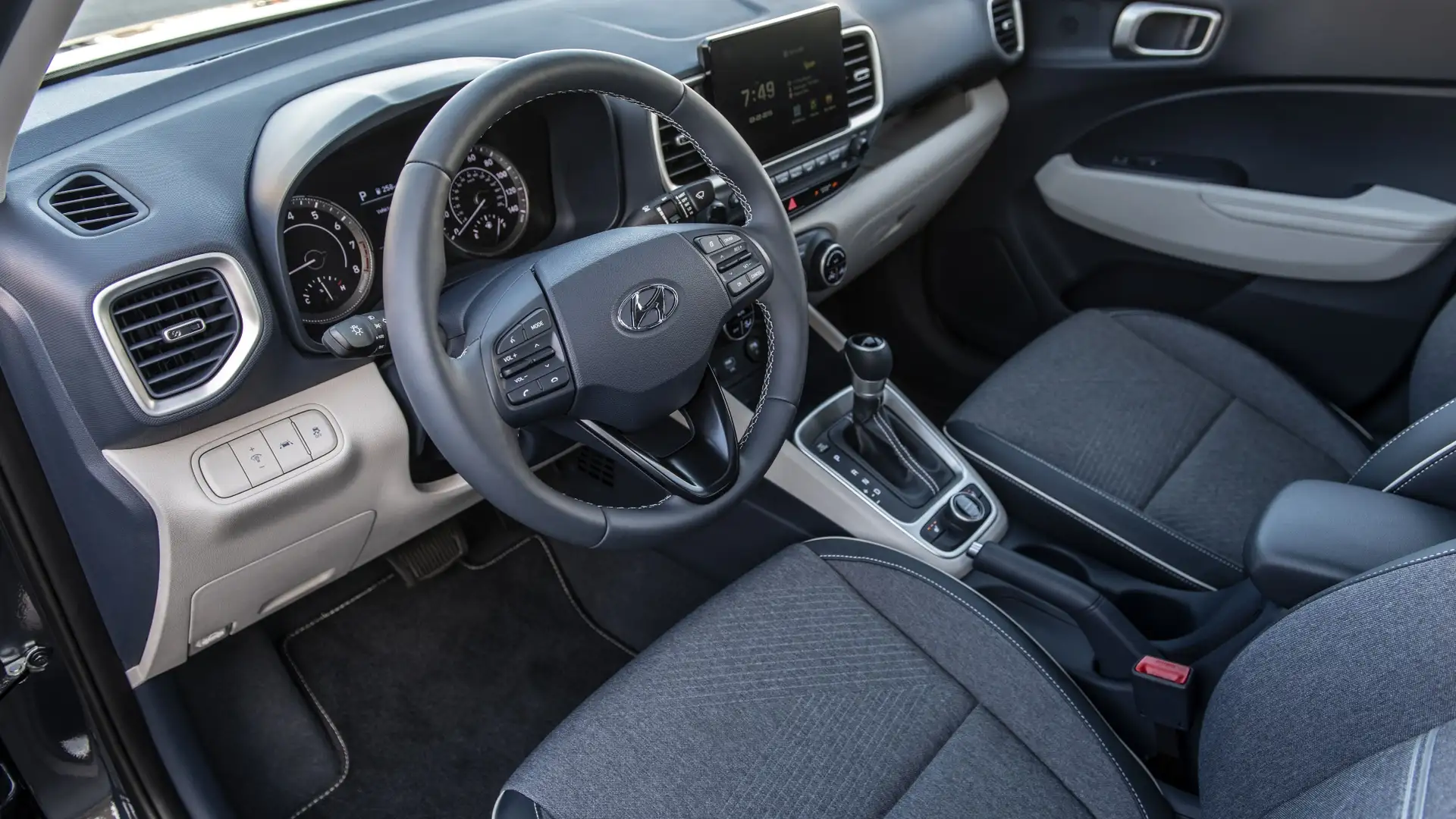
Power from the engine is delivered through an Intelligent Variable Transmission. This transmission is designed to provide a continuously variable ratio range rather than fixed gear steps, allowing the engine to operate within optimal efficiency bands. The system includes a gate-type selector and SHIFTRONIC® functionality, enabling manual gear selection input when required.
The Intelligent Variable Transmission is paired with a front-wheel-drive configuration. Integrated Hill Start Assist Control helps prevent rollback when starting on inclines, and an ignition key interlock system enhances operational safety. The transmission’s gear ratio range spans from 0.385 to 2.680 and 2.822 to 1.822, with final drive ratios calibrated for smooth acceleration and controlled cruising. This configuration prioritizes predictable power delivery and consistent vehicle response in urban and suburban driving environments.
Steering Precision and Chassis Control Systems
The steering system in the 2026 Hyundai Venue uses a rack-and-pinion design with column-mounted motor-driven power steering. This configuration supports responsive steering input while reducing steering effort at low speeds. The overall steering ratio is 14.4 at 360 degrees, and the steering system requires 2.7 turns from lock to lock. These parameters contribute to controlled maneuverability and directional stability.
The minimum turning radius measures 5.1 meters, with a curb-to-curb turning diameter of approximately 16.6 feet. These dimensions allow for efficient operation in confined spaces such as parking structures and residential areas. Steering calibration works in coordination with the vehicle stability systems to maintain predictable handling during directional changes.
Suspension Design and Ride Structure
The suspension system of the 2026 Hyundai Venue is engineered to balance ride comfort and structural simplicity. The front suspension uses a MacPherson® strut configuration with coil springs and a stabilizer bar. Gas-filled twin-tube shock absorbers manage vertical movement and road surface variation.
At the rear, the vehicle uses a coupled torsion beam axle with twin-tube shock absorbers. This rear suspension layout supports space efficiency while maintaining lateral stability. The unibody chassis is constructed primarily from high-tensile steel, contributing to overall rigidity and crash energy management. This structural approach supports consistent suspension geometry under load and enhances long-term durability.
Braking Hardware and Control Technologies
Braking systems on the 2026 Hyundai Venue vary by trim level but maintain consistent control architecture. The front brakes use ventilated disc rotors with an 11.0-inch diameter. Rear braking systems include either drum brakes measuring 8.0 inches or rear disc brakes measuring 10.3 inches, depending on configuration.
The braking system includes Anti-lock Braking System functionality with Electronic Brake-force Distribution. This system manages brake pressure distribution during braking events to reduce wheel lockup and maintain directional control. Additional components include a vacuum booster with a 10.0-inch single diaphragm, a tandem master cylinder with a 0.87-inch diameter, and integrated Brake Assist. These elements work together to provide stable braking performance across varying road conditions.
Exterior Dimensions and Structural Measurements
The exterior dimensions of the 2026 Hyundai Venue reflect its compact classification. The wheelbase measures 99.2 inches, while overall length is 159.1 inches. Overall width excluding mirrors is 69.7 inches, and overall height measures 61.6 inches. Front and rear overhangs measure 31.1 inches and 28.7 inches, respectively.
Ground clearance is rated at 6.69 inches, supporting light off-pavement operation and urban obstacle clearance. Track width varies by wheel size, measuring 61.2 inches front and 61.6 inches rear with 15-inch wheels, and 60.4 inches front and 60.9 inches rear with 17-inch wheels. The coefficient of drag is measured at 0.34. Approach, departure, and ramp breakover angles are 21.3 degrees, 32.0 degrees, and 19.2 degrees, respectively.
Exterior Equipment and Lighting Systems
The exterior of the 2026 Hyundai Venue incorporates functional design elements with standardized lighting technology. Projector headlights with automatic control are standard, improving forward visibility and adapting to ambient lighting conditions. One-touch triple turn signals enhance signaling clarity during lane changes, and lenticular-effect taillights improve rear visibility.
Wheel configurations include 15-inch alloy wheels paired with 185/65 R15 tires or 17-inch alloy wheels paired with 205/55 R17 tires. A compact temporary spare tire is included, mounted on a steel wheel. Heated power-adjustable side mirrors are available depending on trim, with body-color or roof-color finishes. A power glass sunroof with tilt and slide functionality is available on select trims.
Interior Space Allocation and Seating Configuration
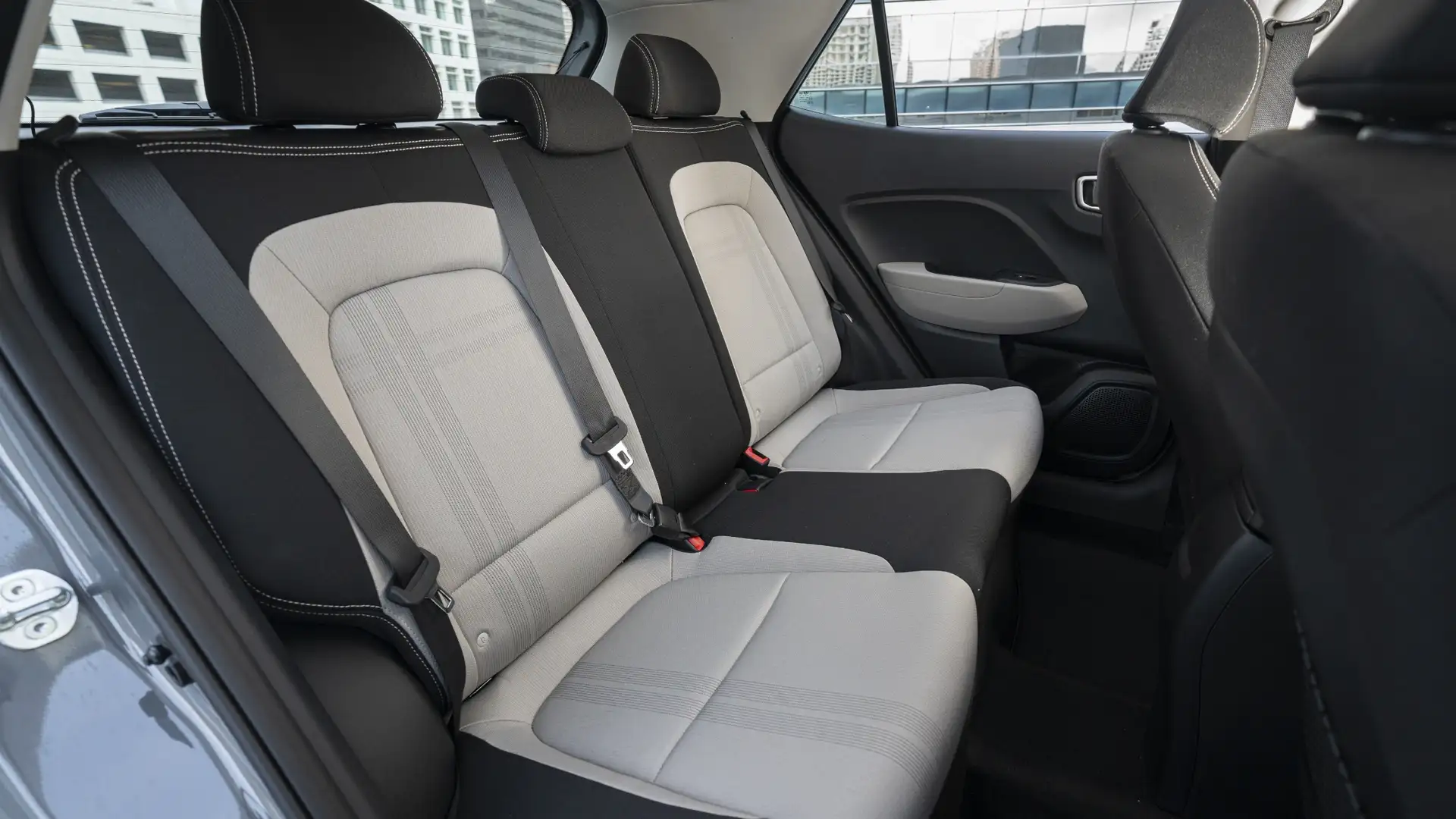
The interior of the 2026 Hyundai Venue is configured to seat five passengers. Passenger volume totals 91.9 cubic feet. Headroom measures 39.4 inches in the front and 38.6 inches in the rear without a sunroof and 38.4 inches in the front with a sunroof. Legroom measures 41.3 inches in the front and 34.3 inches in the rear.
Seating surfaces include cloth or a cloth and H-Tex® combination, depending on trim. The driver seat features six-way manual adjustment, including height adjustment and sliding and reclining functions. Heated front seats are available on higher trims. The rear seat uses a 60/40 split-folding configuration, allowing cargo volume to expand from 18.7 cubic feet to 31.9 cubic feet when folded. Total interior volume measures 110.6 cubic feet.
Cabin Controls, Instrumentation, and Connectivity
The 2026 Hyundai Venue features an 8-inch touchscreen display audio system with integrated AM and FM radio. Wireless Android Auto™ and Apple CarPlay® functionality allow smartphone integration without physical connections. Audio output is managed through a six-speaker system, including tweeters and door-mounted speakers.
The cabin includes multiple USB charging ports, including Type-A and Type-C ports in the front and available second-row Type-C ports. Wireless device charging using the Qi format is available on select trims. Instrumentation displays include speedometer, tachometer, fuel level, temperature, drive mode indicators, distance-to-empty, and warning alerts. Adjustable illumination levels support visibility in varying lighting conditions.
Climate Control and Convenience Systems
Climate management systems include either manual air conditioning or automatic temperature control depending on trim. The HVAC system incorporates a cabin air filter, a rear window defroster with a timer, and a PTC heater. Exterior temperature display is integrated into the trip computer.
Convenience features include power windows, power door locks, cruise control, remote keyless entry or proximity key with push-button start, and multiple storage compartments. Interior lighting includes map lights, cargo area lighting, and illuminated instrument panel switches.
Integrated Safety and Driver Assistance Technologies
Safety systems in the 2026 Hyundai Venue include both passive and active technologies. Passive safety features include advanced front airbags, side-impact airbags, and side curtain airbags covering front and rear seating positions. Seatbelt systems include pretensioners, load limiters, and adjustable shoulder anchors. LATCH anchors support child seat installation.
Active safety technologies include Electronic Stability Control with Traction Control System, Vehicle Stability Management, Tire Pressure Monitoring System, and Brake Assist. Advanced driver assistance systems include Forward Collision-Avoidance Assist with pedestrian detection, Lane Keeping Assist, Driver Attention Warning, and High Beam Assist. Blind-Spot Collision Warning with Rear Cross-Traffic Collision Warning is available on higher trims. Rear Occupant Alert monitors door logic to detect rear-seat activity.
Schedule a Test Ride near Commerce, GA
Drivers seeking direct familiarity with the technical systems described above can evaluate the 2026 Hyundai Venue through an in-person driving session. At ALM Hyundai of Athens near Commerce, GA, visitors can schedule a test drive to observe the engine response, transmission behavior, and integrated safety features under controlled conditions. This experience allows evaluation of steering feedback, braking consistency, and cabin technology operation. The test drive process also provides an opportunity to review interior space utilization and driver assistance system functionality. Appointments can be arranged through the dealership to ensure dedicated access to the vehicle and technical guidance during the evaluation.