

2026 Hyundai Tucson near Loganville, GA
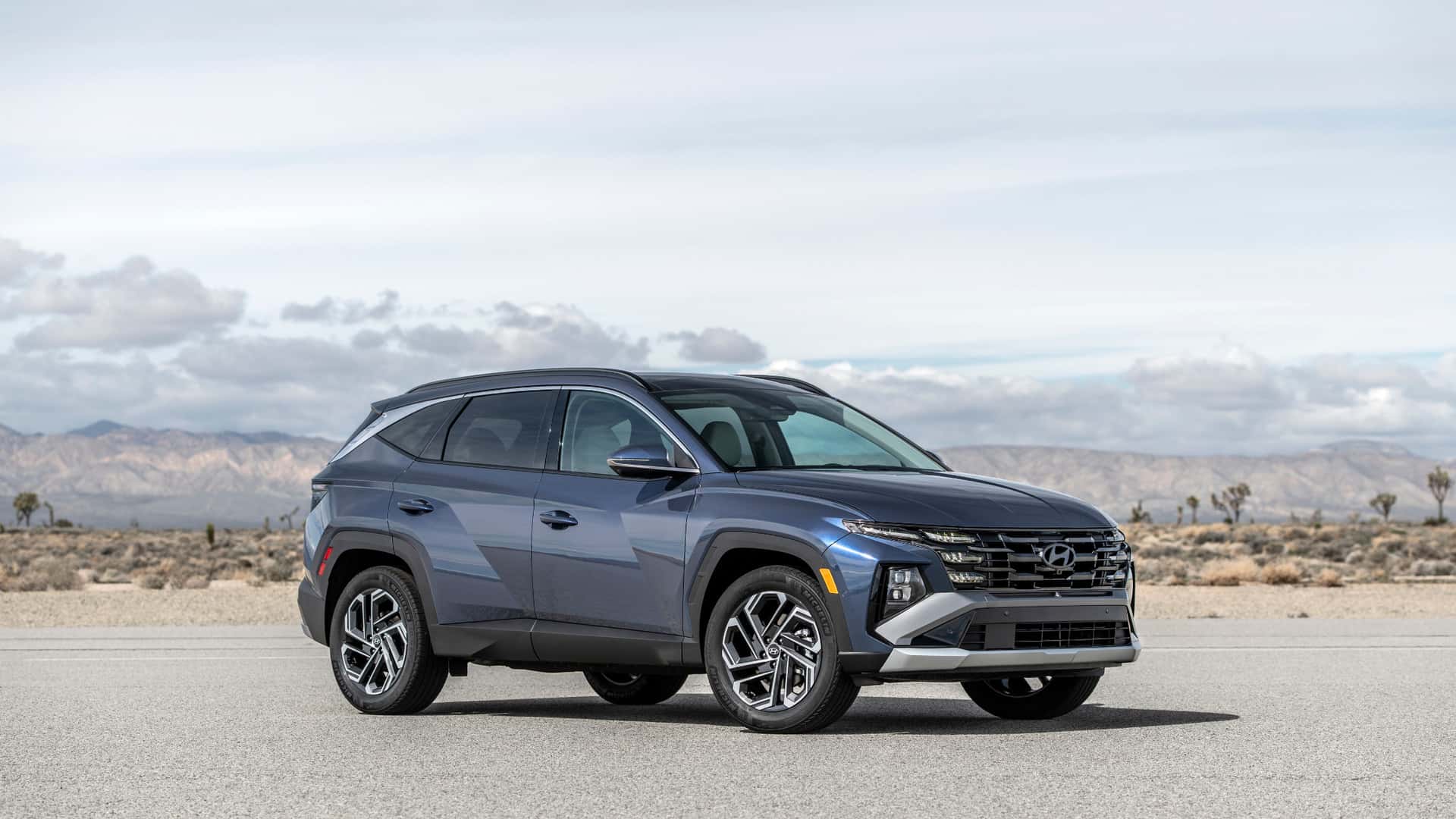
The 2026 Hyundai Tucson is engineered as a compact sport utility vehicle with multiple powertrain options, integrated electronic systems, and a reinforced chassis structure. It incorporates internal combustion, hybrid, and plug-in hybrid configurations within the Smartstream® engine family. Each configuration uses specific mechanical and electrical components to optimize output, efficiency, and drivability. The vehicle supports both front-wheel drive and HTRAC all-wheel drive systems, allowing controlled torque distribution across different road conditions.
Smartstream® Engine Configurations and Output Metrics
The gasoline-powered 2026 Hyundai Tucson uses a 2.5-liter Smartstream® inline 4-cylinder engine with dual fuel injection, combining gasoline direct injection and multi-port injection systems. This engine operates with continuously variable valve timing and produces 187 horsepower at 6,100 RPM and 178 lb-ft of torque at 4,000 RPM. The engine uses an aluminum block and head construction to reduce weight and improve thermal efficiency. The compression ratio is set at 13.0, and the engine includes a variable intake system to regulate airflow based on operating conditions. Idle Stop and Go functionality is included to reduce fuel consumption during stationary operation.
Hybrid and plug-in hybrid models use a 1.6-liter turbocharged Smartstream® engine with continuously variable valve duration. This engine produces 178 horsepower and 195 lb-ft of torque from 1,500 to 4,500 RPM. The hybrid system integrates a permanent magnet synchronous motor that contributes additional output. Total system output reaches 231 horsepower for the hybrid model and 268 horsepower for the plug-in hybrid configuration. Both electrified variants generate 271 lb-ft of torque through combined engine and motor operation.
The hybrid electric motor produces 64 horsepower and 195 lb-ft of torque. The plug-in hybrid motor increases output to 97 horsepower and 224 lb-ft of torque. The hybrid battery operates at a maximum voltage of 270 volts with a capacity of 1.49 kWh. The plug-in hybrid battery operates at 360 volts and has a capacity of 13.8 kWh. The plug-in hybrid includes a 7.2 kW onboard charger capable of completing a full charge in approximately two hours when connected to a 240-volt source.
Transmission Systems and Drivetrain Control
The 2026 Hyundai Tucson uses different transmission systems depending on the selected powertrain. Gasoline models are equipped with an 8-speed automatic transmission using a torque converter. Hybrid and plug-in hybrid models use a 6-speed automatic transmission. Both transmission types are calibrated for smooth gear transitions and optimized fuel efficiency.
Drive configurations include standard front-wheel drive and an available HTRAC all-wheel drive system. The all-wheel drive system uses active on-demand torque distribution to adjust power delivery between the front and rear axles. A center-console mounted drive mode selector allows the driver to adjust vehicle behavior based on road conditions. Paddle shifters are available on select trims to provide manual gear control. Shift-by-wire technology replaces traditional mechanical linkages, improving packaging efficiency and reducing mechanical complexity.
Suspension Geometry and Steering Precision
The 2026 Hyundai Tucson uses a MacPherson® strut front suspension combined with coil springs and a stabilizer bar. The rear suspension uses a multi-link configuration with gas-pressurized shock absorbers. This setup improves ride stability and reduces body roll during cornering. The suspension system is tuned to balance comfort and control across varying road surfaces.
Steering is managed through a column-mounted motor-driven power steering system with a rack-and-pinion layout. The steering ratio is 13.7 to 1, and the system requires 2.41 turns from lock to lock. The turning diameter is measured at 38.6 feet, allowing maneuverability in confined spaces. Steering response is calibrated to provide consistent feedback during low-speed and highway driving.
Braking Systems and Control Technologies
The braking system uses ventilated front disc brakes measuring 12.8 inches in diameter and solid rear disc brakes measuring 12.0 inches. The system includes anti-lock braking with electronic brake-force distribution to regulate braking pressure across all wheels. Brake Assist increases stopping power during emergency braking situations.
Additional control systems include Downhill Brake Control and Hillstart Assist Control. These systems manage braking force during steep descents and prevent rollback when starting on an incline. An electronic parking brake with automatic vehicle hold functionality maintains brake pressure when the vehicle is stationary.
Structural Design and Exterior Engineering
The 2026 Hyundai Tucson uses a unibody structure constructed from advanced high-strength steel and high-tensile materials. This construction improves impact resistance and reduces flex during operation. The exterior dimensions include a wheelbase of 108.5 inches, an overall length of 182.7 inches, and a width of 73.4 inches. The height varies between 65.6 inches for front-wheel drive models and 66.3 inches for all-wheel drive models.
The aerodynamic profile results in a drag coefficient of 0.33. Exterior features include Bi-LED headlights with integrated daytime running lights and high beam assist functionality. Lighting systems are designed to improve visibility without increasing energy consumption.
Wheel options include 17-inch, 18-inch, and 19-inch alloy configurations paired with corresponding tire sizes. Roof rails provide a load capacity of 220 pounds. Additional features include a hands-free smart liftgate, a panoramic sunroof on select trims, and acoustic laminated glass to reduce interior noise levels.
Interior Configuration and Passenger Space
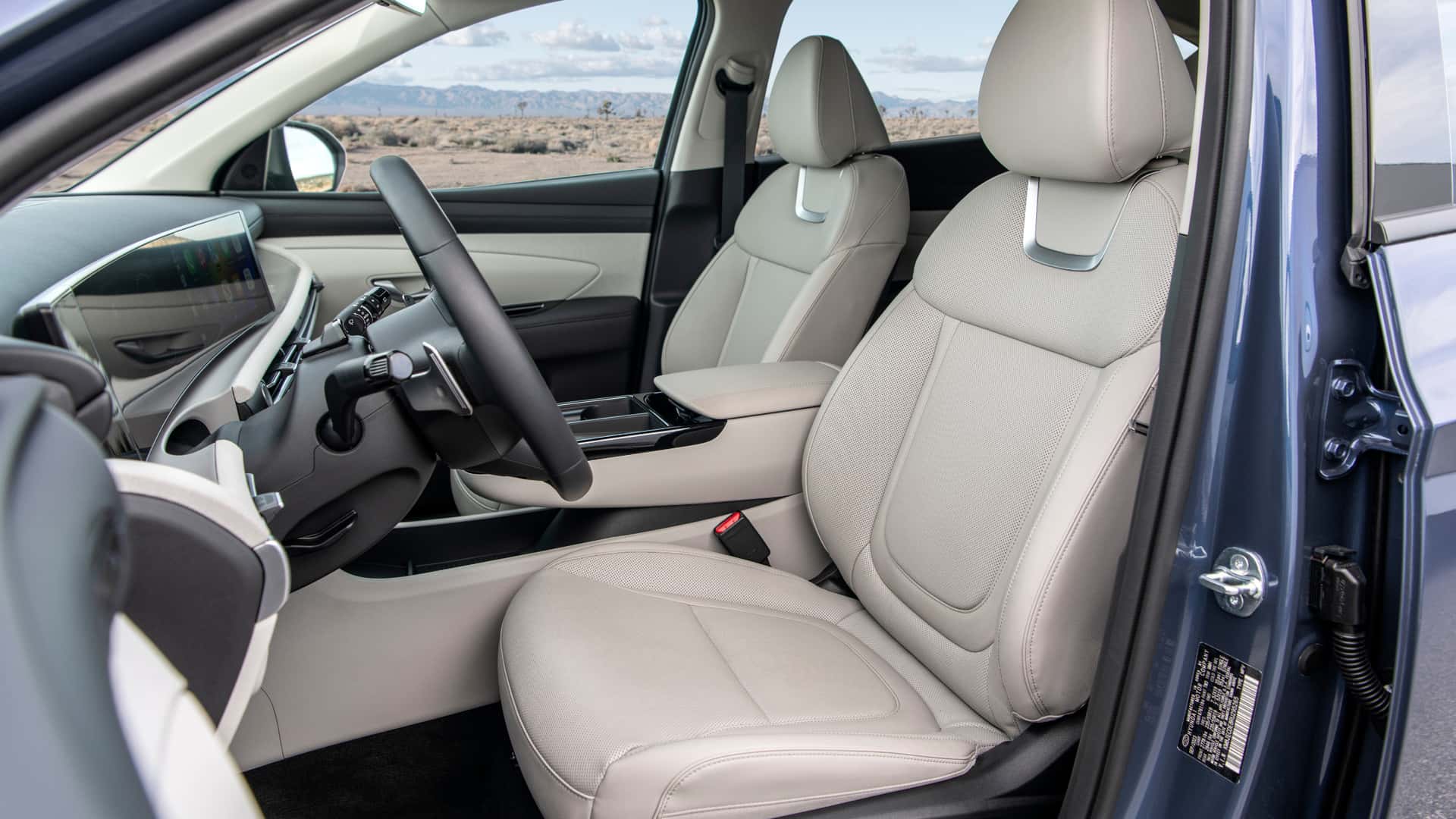
The cabin is configured to accommodate five passengers with multiple seating material options, including cloth, H-Tex® leatherette, and leather-trimmed surfaces. The driver seat is available with 8-way power adjustment and lumbar support. Heated and ventilated front seats are included on higher trims, while rear seats offer heating functionality.
The rear seating configuration includes a 60 and 40 split-folding design with reclining capability. Cargo space measures up to 74.8 cubic feet in gasoline models when rear seats are folded. Hybrid models provide similar capacity, while plug-in hybrid models offer slightly reduced cargo volume due to battery placement.
Interior dimensions provide 41.4 inches of front legroom and up to 41.3 inches of rear legroom. Shoulder room measures 57.6 inches in the front and 56.0 inches in the rear. Headroom varies depending on sunroof configuration, with reduced clearance when panoramic systems are installed.
Infotainment Systems and Digital Interfaces
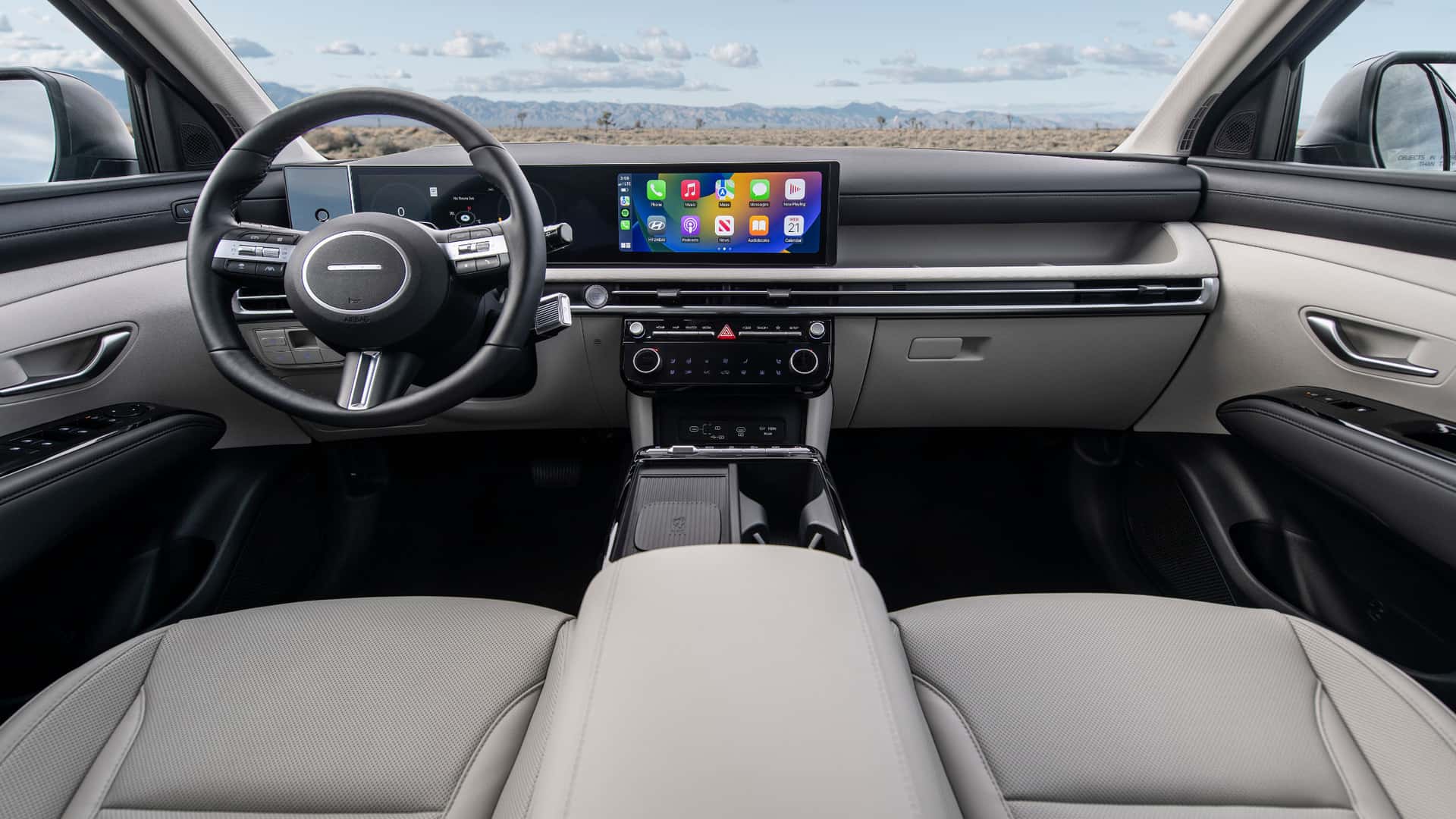
The 2026 Hyundai Tucson integrates a 12.3-inch touchscreen display that supports audio, navigation, and connectivity functions. Wireless Apple CarPlay® and Android Auto™ are included across all trims. SiriusXM® satellite radio and HD Radio™ technology provide additional audio sources.
Higher trims include onboard navigation with over-the-air update capability for maps and multimedia systems. The available Bose® premium audio system uses an 8-speaker configuration with digital signal processing and speed-sensitive volume adjustment.
Connectivity features include multiple USB-C ports in both front and rear seating areas. Wireless charging supports 15-watt output for compatible devices. The Hyundai Digital Key 2 Premium system allows smartphone-based vehicle access using near field communication, Bluetooth® low energy, and ultra-wideband technology.
Climate Control and Cabin Systems
The 2026 Hyundai Tucson includes manual air conditioning in base trims and dual automatic temperature control in higher trims. The automatic system uses capacitive touch controls with dedicated knobs for temperature adjustment. Rear passengers benefit from dedicated air vents and heater ducts.
The HVAC system includes an auto defogger, cabin air filter, and after-blow function to reduce moisture buildup. Rear window defrosters operate with a timed cycle to maintain visibility in cold conditions.
Driver Assistance and Safety Integration
The 2026 Hyundai Tucson includes a comprehensive set of safety features. The airbag system includes front, side-impact, curtain, and rear side airbags. The occupant classification system uses seat sensors to adjust airbag deployment based on passenger weight and position.
Active safety technologies include Forward Collision-Avoidance Assist with detection for pedestrians, cyclists, and junction turning scenarios. Blind-Spot Collision Warning and Rear Cross-Traffic Collision-Avoidance Assist provide monitoring for adjacent and rear traffic conditions. Lane Keeping Assist and Lane Following Assist maintain vehicle alignment within lane markings.
Additional systems include Intelligent Speed Limit Assist, Driver Attention Warning, and Safe Exit Warning. Higher trims include Highway Driving Assist, which integrates adaptive cruise control with lane centering. Parking systems include Surround View Monitor and Parking Collision-Avoidance Assist for improved maneuvering in confined areas.
Dimensions, Capacity, and Functional Measurements
The 2026 Hyundai Tucson provides a total interior volume of up to 146.9 cubic feet in gasoline models. Passenger volume measures approximately 108.2 cubic feet. Cargo capacity with rear seats in place measures 38.7 cubic feet and expands significantly when seats are folded.
Fuel tank capacity is 14.3 gallons for gasoline models, 13.7 gallons for hybrid models, and 11.1 gallons for plug-in hybrid configurations. Ground clearance ranges from 7.1 inches in front-wheel drive models to 8.3 inches in all-wheel drive variants. These measurements support moderate off-road capability and daily driving requirements.
Schedule a Test Ride near Loganville, GA
Drivers seeking a compact SUV with multiple powertrain configurations and integrated safety systems can evaluate the 2026 Hyundai Tucson directly. The model provides measurable outputs in horsepower, torque, and system integration across all variants. A test drive allows assessment of transmission response, steering calibration, and suspension behavior under controlled conditions. Technology features such as the digital display interface and driver assistance systems can be reviewed during operation. Visit ALM Hyundai of Athens near Loganville, GA, to schedule a test drive and examine the 2026 Hyundai Tucson’s technical systems in detail.