

2026 Hyundai Tucson near Buford, GA
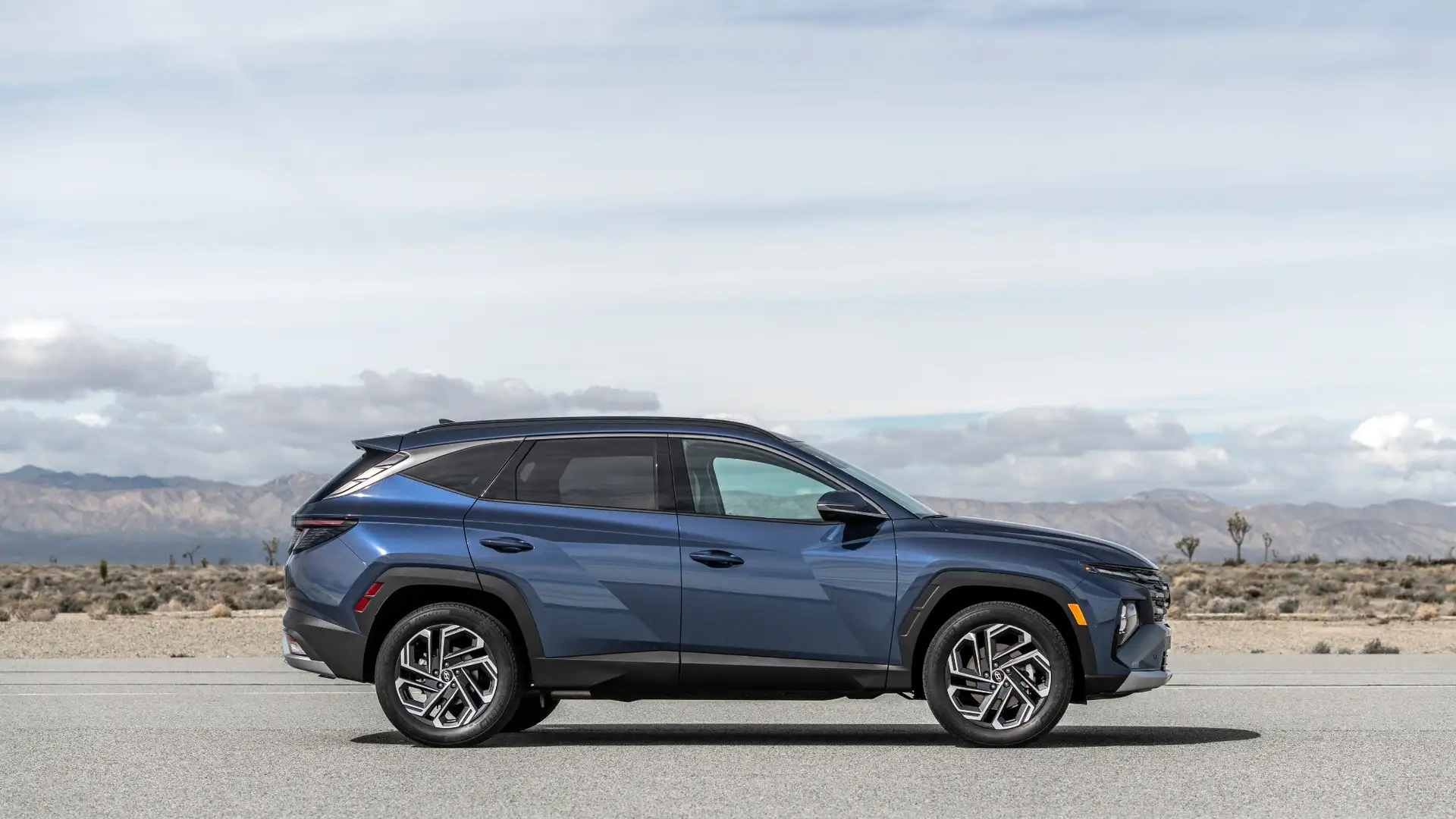
The 2026 Hyundai Tucson is engineered as a compact sport utility vehicle that integrates multiple powertrain options, advanced chassis design, and a comprehensive suite of technology and safety systems. Designed to support gasoline, hybrid, and plug-in hybrid configurations, the 2026 Hyundai Tucson delivers consistent mechanical performance while maintaining structural rigidity and interior versatility. Each component of the vehicle is developed to support efficiency, durability, and driver assistance integration, resulting in a technically balanced platform suitable for varied driving environments.
Smartstream® Powertrain Architecture and Engine Output
The 2026 Hyundai Tucson offers a dual-engine strategy across its lineup, beginning with a naturally aspirated 2.5-liter Smartstream® inline four-cylinder gasoline engine. This powerplant features dual overhead camshafts, a 16-valve configuration, and a combined gasoline direct injection and multi-port injection system. Total displacement measures 2,497 cubic centimeters, supported by an aluminum engine block and cylinder head. The engine produces 187 horsepower at 6,100 revolutions per minute and delivers 178 pound-feet of torque at 4,000 revolutions per minute. Continuously variable valve timing contributes to optimized combustion efficiency across a wide operating range, while a variable intake system manages airflow based on engine load.
Hybrid and plug-in hybrid variants utilize a 1.6-liter turbocharged Smartstream® inline four-cylinder engine paired with an electric motor. This engine employs continuously variable valve duration technology to adjust valve opening profiles based on driving conditions. In hybrid configuration, the combined system output reaches 231 horsepower, while the plug-in hybrid system produces a total of 268 horsepower. Both electrified variants generate 271 pound-feet of combined torque, with electric motor assistance contributing immediate low-speed response.
Electric Drive Components and Battery Systems
The 2026 Hyundai Tucson hybrid integrates a permanent magnet synchronous electric motor producing 64 horsepower, with peak torque available at low rotational speeds. Energy is stored in a lithium-ion battery rated at 1.49 kilowatt-hours, operating at a maximum voltage of 270 volts. The plug-in hybrid configuration increases electric motor output to 97 horsepower and raises system voltage to 360 volts. Battery capacity expands to 13.8 kilowatt-hours, enabling extended electric-only operation when charged.
The 2026 Hyundai Tucson plug-in hybrid system includes an onboard 7.2-kilowatt charger compatible with 240-volt power sources, allowing a full charge in approximately two hours. Battery power output reaches 88 kilowatts in the plug-in hybrid model, supporting sustained electric assistance during acceleration and cruising. Both electrified systems are engineered to maintain consistent thermal regulation and electrical efficiency.
Transmission Systems and Drivetrain Management
The 2026 Hyundai Tucson is equipped with an 8-speed automatic transmission using a torque converter design. Gear ratios are optimized for smooth power delivery and reduced engine load during highway operation. Hybrid and plug-in hybrid models utilize a 6-speed automatic transmission calibrated specifically for integration with the electric motor. Shift-by-wire technology is standard across multiple trims, enabling electronic gear selection with reduced mechanical complexity.
Front-wheel drive is standard across most configurations, while the Hyundai HTRAC all-wheel-drive system is available to provide active torque distribution between the front and rear axles. The system continuously monitors wheel slip and traction demands to adjust power delivery accordingly. Drive mode selection is controlled through a center-console interface, allowing changes to throttle mapping and drivetrain behavior.
Steering Geometry, Braking Systems, and Handling Control
The 2026 Hyundai Tucson employs a motor-driven power steering system with a column-mounted rack-and-pinion configuration. The steering ratio is set at 13.7 to one, with a lock-to-lock turning measurement of 2.41 turns. The curb-to-curb turning diameter measures 38.6 feet, supporting maneuverability in urban environments.
Braking hardware includes ventilated front disc brakes measuring 12.8 inches in diameter and solid rear disc brakes measuring 12.0 inches. Anti-lock braking, electronic brake-force distribution, brake assist, and electronic stability control are standard across all trims. An electronic parking brake with automatic vehicle hold functionality is also standard, along with downhill brake control and hill-start assist systems.
Suspension Design and Structural Composition
The 2026 Hyundai Tucson is constructed using a unibody monocoque chassis composed primarily of advanced high-strength steel and high-tensile steel materials. This structure supports improved torsional rigidity while managing overall vehicle mass. The front suspension uses a MacPherson® strut design with coil springs and gas-pressurized shock absorbers. The rear suspension employs a multi-link configuration with a stabilizer bar, supporting ride stability and controlled handling.
Ground clearance varies by drivetrain, measuring 7.1 inches for front-wheel-drive models and up to 8.3 inches for all-wheel-drive configurations. The aerodynamic profile achieves a coefficient of drag of 0.33, contributing to improved highway stability and reduced wind resistance.
Exterior Lighting, Wheel Options, and Functional Design
Exterior lighting systems include bi-LED headlights with high and low beam functionality, LED daytime running lights, LED turn signals, and LED taillights. Automatic headlight operation and High Beam Assist are standard features. Projector-type headlamps and premium daytime running light designs are available on higher trims.
Wheel sizes range from 17-inch alloy wheels to 19-inch alloy wheels, paired with tire dimensions up to 235 over 55. Roof rails are available across multiple trims and support a maximum load of 220 pounds. Additional exterior elements include an integrated rear spoiler, hands-free smart liftgate with adjustable height, shark-fin antenna, trailer pre-wiring, and available panoramic sunroof with power shade operation.
Interior Seating Systems and Cargo Configuration
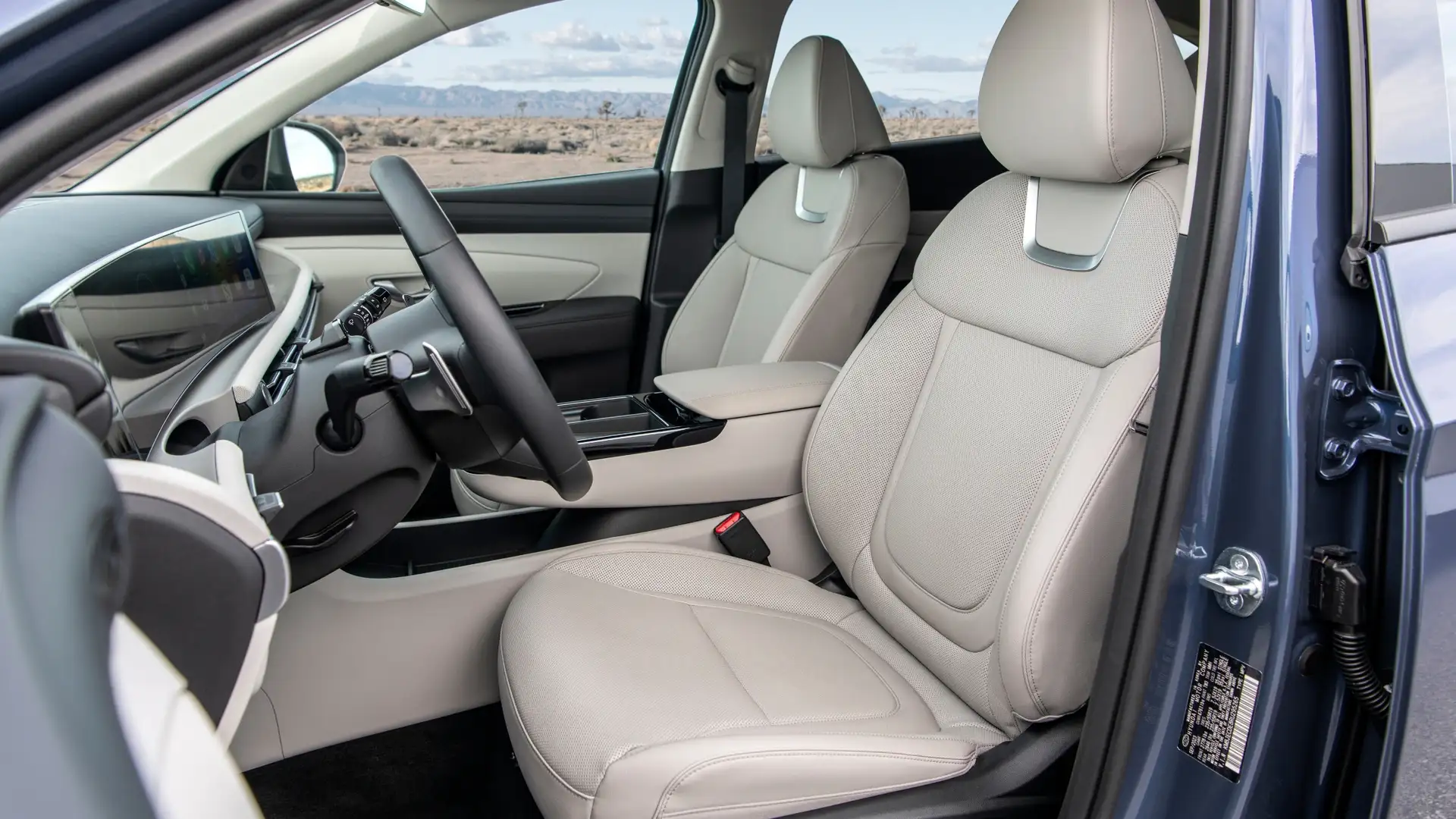
The interior of the 2026 Hyundai Tucson accommodates five occupants and offers multiple seating surface options depending on trim level. Standard cloth seating surfaces are treated for stain and odor resistance. H-Tex® leatherette seating and leather-trimmed seating surfaces are available on higher trims. Front seating configurations include six-way manual adjustment or eight-way power adjustment, along with available power lumbar support.
Heated front seats are standard on select trims, while ventilated front seats and heated rear seats are available on upper trims. Rear seating features a 60/40 split fold-down design with reclining capability and adjustable head restraints. Dual-level cargo floor design is standard across most configurations. Cargo capacity measures up to 38.7 cubic feet with rear seats upright and up to 74.8 cubic feet with seats folded in gasoline models.
Digital Displays, Connectivity, and Multimedia Systems
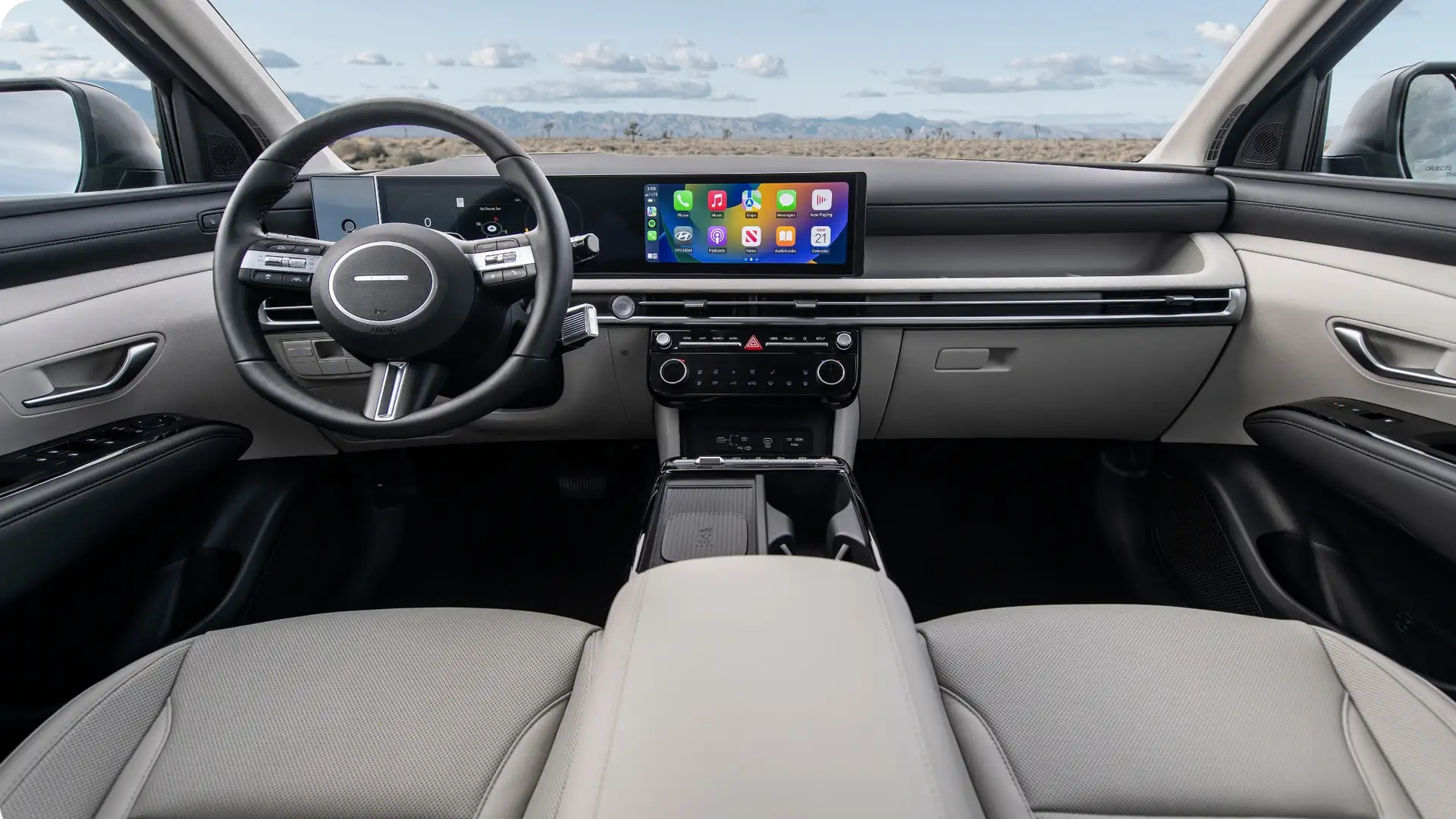
The 2026 Hyundai Tucson features a 12.3-inch color touchscreen display across multiple trims. Base configurations include AM and FM radio, HD Radio™, SiriusXM® capability, and six-speaker audio output. Higher trims add onboard navigation through the brand’s connected navigation cockpit system, along with over-the-air update capability for maps and multimedia software.
Wireless Apple CarPlay® and Android Auto™ are standard across all trims. USB Type-C ports are located in both the front and rear seating areas, providing up to 27 watts of charging power. A Bose® premium audio system with eight speakers, digital signal processing, and dynamic speed compensation is available on Limited trims.
Climate Control and Interior Environment Systems
Climate control systems include manual air conditioning on base trims and dual automatic temperature control on higher trims. Capacitive-touch controls are paired with physical temperature adjustment knobs. After-blow logic reduces moisture buildup within the HVAC system. Rear seat air vents and heater ducts support consistent airflow throughout the cabin.
Acoustic laminated windshield glass and front side windows are used to reduce exterior noise intrusion. Interior lighting includes LED overhead lighting, ambient lighting with selectable color settings, illuminated power window switches, and LED cargo area lighting.
Driver Assistance and Active Safety Technologies
The 2026 Hyundai Tucson is equipped with Hyundai SmartSense safety technologies. Standard systems include forward collision-avoidance assist with pedestrian, cyclist, and junction turning detection; blind-spot collision warning; rear cross-traffic collision-avoidance assist; lane keeping assist; lane following assist; driver attention warning; and intelligent speed limit assist.
Higher trims add navigation-based smart cruise control with curve control, highway driving assist, surround view monitor, blind-spot view monitor, parking collision-avoidance assist, and remote smart parking assist. Passive safety systems include a comprehensive airbag array, reinforced body structure, immobilizer system, and integrated anti-theft features.
Dimensions, Interior Space, and System Capacities
The 2026 Hyundai Tucson measures 182.7 inches in overall length with a wheelbase of 108.5 inches and an overall width of 73.4 inches. Overall height measures 65.6 inches for front-wheel-drive models and 66.3 inches for all-wheel-drive models. Interior dimensions provide balanced headroom, legroom, shoulder room, and hip room for both rows of seating.
Fuel tank capacity measures 14.3 gallons for gasoline models, 13.7 gallons for hybrid models, and 11.1 gallons for plug-in hybrid configurations. Total interior volume reaches up to 146.9 cubic feet in gasoline models without a panoramic sunroof.
Visit ALM Hyundai of Athens to Schedule a Test Ride
Drivers interested in examining the engineering depth of the 2026 Hyundai Tucson can experience its drivetrain response, digital interfaces, and safety technologies through a scheduled test drive at ALM Hyundai of Athens near Buford, GA. Observing the vehicle’s acceleration behavior, steering feedback, and driver-assistance integration provides practical insight into how its systems function together. A test drive allows evaluation of ride comfort, power delivery, and interior ergonomics across various driving conditions. Scheduling an in-person experience offers a comprehensive understanding of how the mechanical and technological systems of the 2026 Hyundai Tucson support daily operation and long-term usability.