

2026 Hyundai Tucson Hybrid nearby Loganville, GA
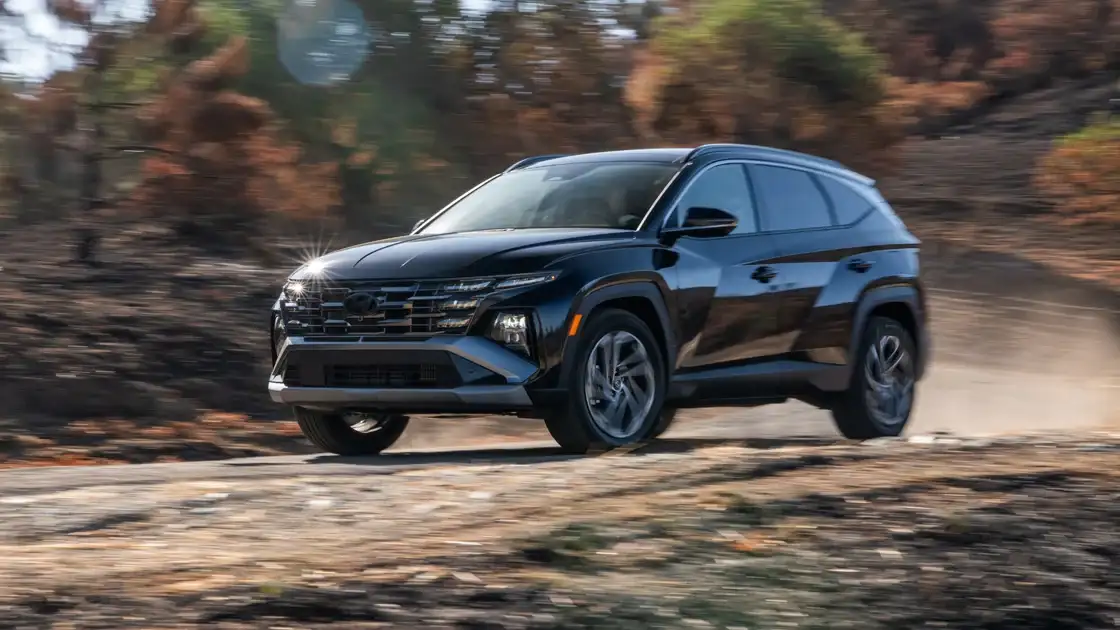
The 2026 Hyundai Tucson Hybrid is a five-passenger small SUV that combines a turbocharged gasoline engine with an electric motor, a lithium-ion battery, and standard HTRAC all-wheel drive. Its hybrid system produces 231 horsepower and 271 lb-ft of total system torque through a six-speed automatic transmission. The vehicle also uses a unibody structure, four-wheel independent suspension, four-wheel disc brakes, and motor-driven power steering. Inside, the 2026 Hyundai Tucson Hybrid provides flexible rear seating, digital connectivity, automatic climate control, and multiple device-charging connections. Its technical equipment covers powertrain operation, chassis control, passenger comfort, cargo utility, multimedia functions, occupant protection, and driver-assistance technology.
Hybrid powertrain and driving systems
The mechanical configuration of the 2026 Hyundai Tucson Hybrid coordinates gasoline and electric power through a conventional automatic transmission. Hyundai equips every hybrid model with HTRAC active on-demand all-wheel drive. Steering-wheel paddle shifters and a shift-by-wire interface also come standard on the hybrid powertrain. A center-console-mounted drive-mode control places supported vehicle settings within reach of the driver. The hybrid system operates alongside a fully independent suspension, four-wheel disc brakes, and multiple electronic chassis-control functions.
Turbocharged gasoline engine
A Smartstream 1.6-liter Turbo-GDI inline four-cylinder engine supplies the gasoline portion of the hybrid system. The engine uses an aluminum block, an aluminum cylinder head, dual overhead camshafts, and 16 valves. Its displacement measures 1,598 cubic centimeters, while its bore and stroke measure 75.6 by 89.0 millimeters. Continuously Variable Valve Duration and a variable intake system manage aspects of airflow and valve operation. The engine also carries a 10.5:1 compression ratio and uses regular unleaded fuel.
The gasoline engine independently produces 178 horsepower at 5,500 rpm. It generates 195 lb-ft of torque across a range from 1,500 to 4,500 rpm. This broad published torque range supports the engine’s role within the combined gasoline-electric system. A full engine cover and a hood insulator with front-fender inner plastic covers form part of the mechanical installation. Hyundai identifies the powertrain with a SULEV30 emissions-control designation.
Electric motor and hybrid battery
A permanent-magnet synchronous motor supplies the electric portion of the 2026 Hyundai Tucson Hybrid powertrain. The motor produces 47.7 kW, or 64 horsepower, from 1,800 to 2,100 rpm. It develops 195 lb-ft of torque at 1,700 rpm. When the motor and gasoline engine operate as a complete system, total output reaches 231 horsepower and 271 lb-ft of torque. These combined ratings distinguish total hybrid-system performance from the separate output figures assigned to the gasoline engine and electric motor.
A 270-volt lithium-ion battery stores electrical energy for the hybrid system. The battery has a capacity of 1.49 kWh and a maximum power output of 64 kW. Unlike the separate plug-in hybrid configuration, the Tucson Hybrid does not include an external charge port or onboard charger. Its hybrid components operate as an integrated part of the vehicle’s propulsion system. The electrical system also eliminates the conventional starter and alternator specifications listed for gasoline-only 2026 Hyundai Tucson Hybrid models.
Six-speed transmission and all-wheel drive
Hyundai pairs the hybrid powertrain with a six-speed automatic transmission that uses a torque converter. The transmission provides ratios of 4.638 in first gear, 2.826 in second, 1.841 in third, 1.386 in fourth, 1.000 in fifth, and 0.772 in sixth. Reverse uses a 3.385 ratio, while the hybrid final-drive ratio is 3.320. Standard steering-wheel paddle shifters allow the driver to make direct gear selections when appropriate. The shift-by-wire system manages transmission commands without a conventional mechanical connection between the selector and gearbox.
HTRAC active on-demand all-wheel drive comes standard across the 2026 Hyundai Tucson Hybrid lineup. The instrument display includes an AWD Lock indicator as part of the hybrid configuration. Electronic Stability Control works with Traction Control and Brake Assist to support controlled vehicle responses. Vehicle Stability Management coordinates supported stability functions, while Hillstart Assist Control helps limit unintended movement on an incline. Driver-selectable Downhill Brake Control assists with maintaining controlled progress during descents.
Suspension, steering, and braking
The front suspension uses MacPherson struts with coil springs, gas-pressurized shock absorbers, and a stabilizer bar. Hyundai equips the rear with a multi-link suspension, gas-pressurized shock absorbers, and a separate stabilizer bar. This independent arrangement allows each wheel to respond through its own suspension components. The vehicle uses a unibody, or monocoque, structure rather than a body mounted on a separate frame. Advanced high-strength steels and high-tensile steel serve as the primary body and chassis materials.
Column-mounted motor-driven power steering operates through a rack-and-pinion mechanism. The system has an overall steering ratio of 13.7:1 and requires 2.41 turns from lock to lock. The 2026 Hyundai Tucson Hybrid has a curb-to-curb turning diameter of 38.6 feet. These published steering measurements define the relationship between driver input, wheel movement, and the space required to complete a turn. A tilt-and-telescoping steering column allows the driver to adjust the steering-wheel position.
The braking system uses ventilated front discs measuring 12.8 inches in diameter and 1.2 inches thick, or 325 by 30 millimeters. Solid rear discs measure 12.0 inches in diameter and 0.4 inches thick, or 300 by 10 millimeters. A four-channel, four-sensor anti-lock braking system monitors all four wheels. Electronic Brake-force Distribution manages braking force, while Brake Assist can supplement driver input under supported conditions. An electronic parking brake includes Automatic Vehicle Hold to maintain brake application after the vehicle stops.
Exterior dimensions and functional utility
The 2026 Hyundai Tucson Hybrid uses exterior dimensions shared across the Tucson range while incorporating hybrid-specific badging and equipment. Its wheelbase and body measurements support a cabin with two seating rows and dedicated rear cargo space. Wheel dimensions vary by trim, and hybrid models use a tire mobility kit instead of the compact temporary spare supplied with gasoline-only versions. LED exterior lighting provides several primary illumination and signaling functions. Available roof, mirror, glass, and liftgate equipment further supports the vehicle’s utility.
Body measurements and wheel equipment
The 2026 Hyundai Tucson Hybrid measures 108.5 inches between the front and rear axles. Overall length is 182.7 inches, and overall width is 73.4 inches. The all-wheel-drive model stands 66.3 inches high when equipped with roof rails and provides 8.3 inches of minimum ground clearance. Front and rear overhangs measure 35.6 and 38.6 inches, respectively. Hyundai lists a coefficient of drag of 0.33 for the body.
Wheel equipment ranges from 17-inch alloys on the Blue SE Hybrid to larger alloy wheels on other supported trims. Published tire sizes include 235/65R17, 235/60R18, and 235/55R19, depending on configuration. Models with 17-inch wheels have front and rear tread widths of 63.8 and 64.1 inches. With 19-inch wheels, the corresponding measurements are 63.6 and 63.9 inches. Every 2026 Hyundai Tucson Hybrid configuration carries a tire mobility kit.
Lighting, mirrors, and exterior equipment
Bi-LED headlights provide both high-beam and low-beam illumination throughout the lineup. The Limited trim uses projector-type Bi-LED headlights. LED front turn signals, LED daytime running lights, automatic headlights, High Beam Assist, and a roof-mounted center high-mount stop lamp are also included. The stop lamp integrates with the body-color rear spoiler. Premium daytime running lights with a half-mirror design appear on the Limited.
Heated outside mirrors come standard on SEL and Limited models. The mirror housings also contain indicators for Blind-Spot Collision Warning and Rear Cross-Traffic Collision-Avoidance Assist. Turn-signal indicators are available or standard on supported upper configurations. Solar glass covers the windshield and front doors, while an acoustic-laminated windshield comes standard throughout the lineup. The Limited adds acoustic-laminated front side windows and premium front and rear fascias.
Front variable-intermittent windshield wipers and an intermittent rear-window wiper and washer are standard. SEL and Limited models add front aero wipers, while the Limited includes rain-sensing operation. Roof side rails come on SEL and Limited models, and available cross rails can increase roof-carrying flexibility. The roof rails have a stated load capacity of 220 pounds. A panoramic sunroof with one-touch opening and a rear shade is included on the Limited.
Cargo capacity and access
The 2026 Hyundai Tucson Hybrid provides 146.7 cubic feet of total interior volume without the panoramic sunroof. Passenger volume measures 107.9 cubic feet under the same roof configuration. With the rear seatbacks upright, SAE cargo capacity measures 38.7 cubic feet, while maximum cargo volume reaches 41.2 cubic feet. Folding the rear seats increases SAE cargo capacity to 74.5 cubic feet. The published maximum with the rear seats folded is 80.0 cubic feet.
A 60/40 split-folding and reclining rear seatback comes standard. Each rear seating position includes an adjustable head restraint, and cargo-area releases allow users to fold the seatbacks from behind the second row. A dual-level cargo floor provides another method of organizing the load space. Six tie-down anchors include two floor anchors and one upper anchor on each side of the cargo area. Bag hooks mounted on the second-row seatbacks provide attachment points for smaller items.
SEL and Limited models include a hands-free Smart Liftgate with automatic opening and an adjustable height setting. Trailer pre-wiring comes standard across the 2026 Hyundai Tucson Hybrid lineup, while tow-hitch availability depends on equipment selection. Roof cross rails are available as port-installed equipment. A retractable cargo cover is also offered as port-installed equipment. These features complement the folding rear seats, configurable cargo floor, and integrated cargo anchors.
Interior comfort and connected technology
The cabin of the 2026 Hyundai Tucson Hybrid combines seating for five with climate controls, storage spaces, digital interfaces, and device connections. Equipment varies among the Blue SE, SEL, SEL Convenience, and Limited configurations. Standard features cover essential media, communication, vehicle access, and passenger-comfort functions. Upper configurations add upgraded seating materials, power adjustments, expanded displays, and additional convenience technology. The two-row layout also maintains substantial front and rear passenger dimensions.
Seating and passenger space
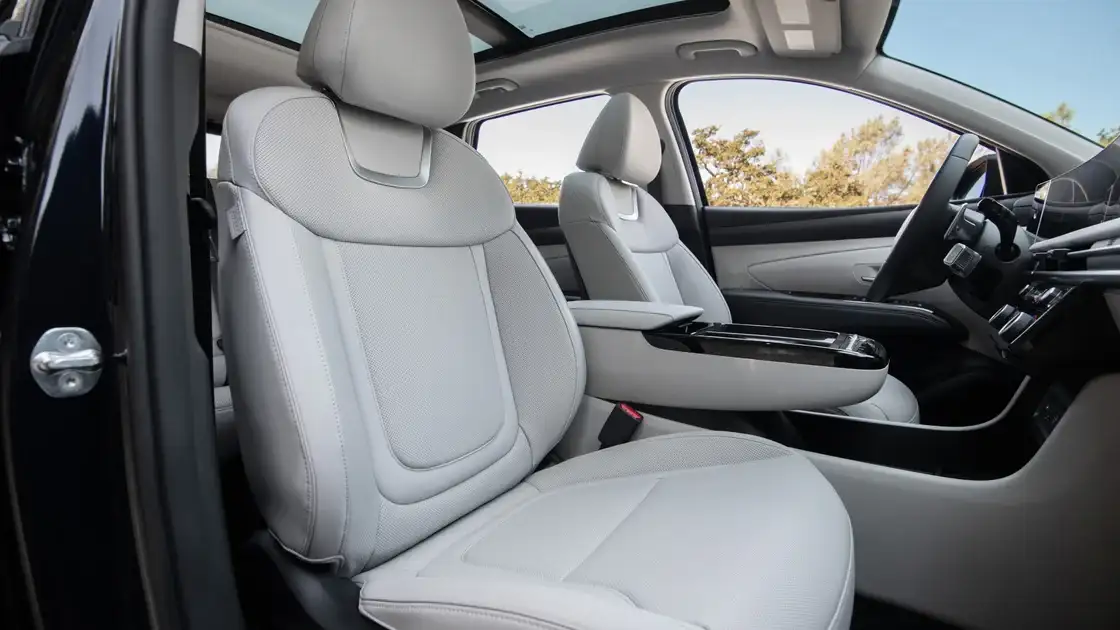
Cloth-trimmed seating with stain- and odor-resistant material appears on supported configurations. H-Tex leatherette seating is available on the SEL Convenience, while the Limited uses leather-trimmed seats. The SEL includes an eight-way power-adjustable driver’s seat, power lumbar support, and three-step heated front seats. Limited equipment adds an eight-way power front-passenger seat, ventilated front seats, and three-level heated rear seats. Its Integrated Memory System stores settings for the driver’s seat and outside mirrors and includes mirror dipping in Reverse.
Front and rear legroom measure 41.4 and 41.3 inches, respectively. Shoulder room measures 57.6 inches in front and 56.0 inches in the second row. The front and rear hip room measures 54.5 and 53.9 inches. Without a sunroof, headroom measures 40.1 inches in front and 39.5 inches in the rear. With the panoramic sunroof, hybrid headroom measures 38.1 inches in front and 38.7 inches in the rear.
Climate controls and steering-wheel equipment
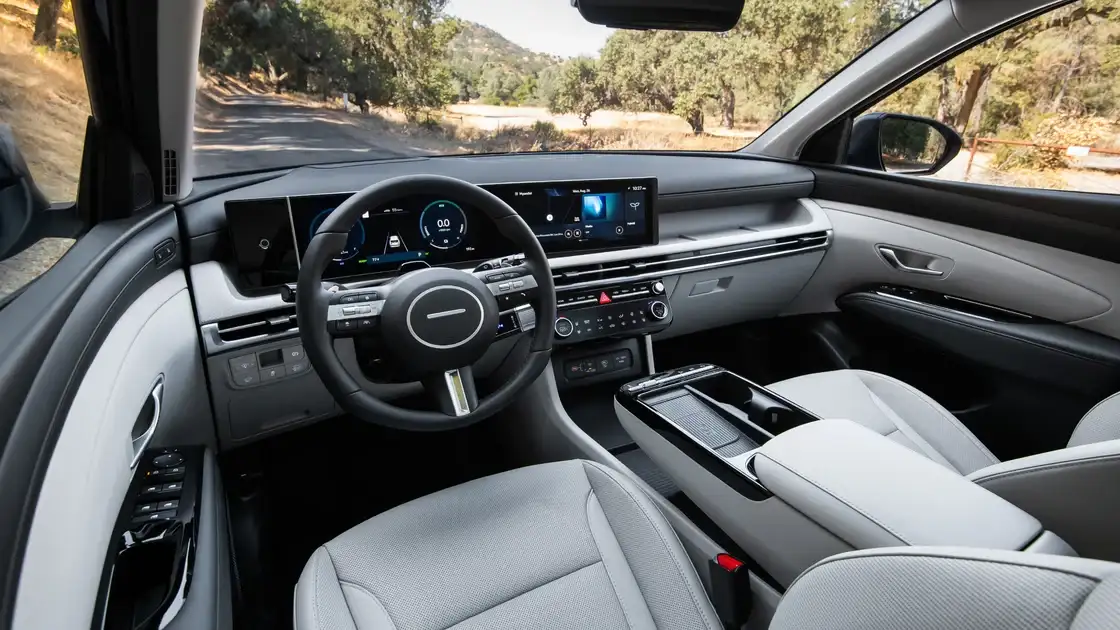
Dual automatic temperature control comes standard across the 2026 Hyundai Tucson Hybrid lineup. The system includes automatic defogging, capacitive-touch controls, and physical knobs for temperature adjustment. After-Blow logic, an exterior-temperature display, a cabin air filter, rear-seat heater ducts, and floor-console-mounted rear air-conditioning vents are also standard. A timed rear-window defroster supports rearward visibility in appropriate conditions. The heating and ventilation equipment serves both seating rows through dedicated outlets and ducts.
Every model uses a three-spoke steering wheel with tilt-and-telescoping adjustment. Integrated switches manage audio volume, muting, track selection, media modes, Bluetooth functions, and cruise control. A leather-wrapped steering wheel is available on the SEL Convenience and standard on the Limited. The Limited also includes steering-wheel heating with high and low settings. Paddle shifters position transmission controls behind the steering wheel throughout the hybrid lineup.
Multimedia and device connectivity
A 12.3-inch color touchscreen serves as the primary multimedia interface. Supported functions include AM/FM radio, HD Radio technology, SiriusXM satellite radio, wireless Apple CarPlay, and wireless Android Auto. The system uses six speakers on applicable configurations and supports controller over-the-air updates. A rearview camera displays through the multimedia system when the driver selects Reverse. The Bluelink+ Connected Car System also comes standard.
Front occupants receive two USB Type-C ports. One port supports data and charging, while the second supplies up to 27 watts for charging. Two additional 27-watt USB charging ports serve second-row passengers. The cabin also includes two 12-volt outlets, with one positioned in front and another in the cargo area. A 15-watt wireless device charger is available on the SEL Convenience and standard on the Limited.
The Limited adds a 12.3-inch digital instrument cluster and a 12.3-inch touchscreen with onboard navigation. Its Bose premium audio system uses a digital eight-channel amplifier with custom equalization, Digital Signal Processing, and Dynamic Speed Compensation. The eight-speaker arrangement includes a center instrument-panel Twiddler, two tweeters, front-door speakers, rear-door speakers, and a rear-quarter-panel woofer. Dynamic Voice Recognition provides another method for controlling compatible functions. Map and multimedia software can receive over-the-air updates.
Instrumentation and convenience functions
Standard instrumentation includes a speedometer, tachometer, coolant-temperature display, fuel gauge, digital odometer, and trip odometer. The display identifies the selected transmission range and shows the current gear during manual operation. Indicators cover Smart Cruise Control with Stop & Go, High Beam Assist, parking-brake status, and multiple driver-assistance systems. Warning lights monitor oil pressure, battery charge, airbags, seatbelts, ABS, tire pressure, stability control, power steering, and Downhill Brake Control. Drivers can adjust the illumination level of the instrument display.
Proximity-key entry with push-button start comes standard, as does remote keyless entry with alarm and panic functions. Each proximity key contains a detachable valet key. Interior storage includes a tray below the front 12-volt outlet, a fixed center-console armrest box, front cupholders, a damped glove compartment, and a rear center armrest with cupholders. Four assist grips and a rear coat hanger add further utility. Front and rear LED overhead lights, an LED cargo-area light, and illuminated power-window switches support cabin visibility.
The Limited adds Remote Smart Parking Assist, an auto-dimming rearview mirror with HomeLink, and an illuminated glove compartment. Hyundai Digital Key 2 Premium functionality is available on supported configurations. The system uses near-field communication, Bluetooth Low Energy, and ultra-wideband technologies. Available 64-color ambient lighting covers the upper center console on shift-by-wire models, the front-passenger dashboard tray, and the front-door pockets. Power door locks and front auto-down and auto-up windows provide additional operating convenience.
Safety and driver-assistance technology
The 2026 Hyundai Tucson Hybrid combines occupant restraints, child-seat provisions, braking controls, stability systems, and driver-assistance functions. Standard technologies monitor forward, side, and rear traffic conditions while supporting lane positioning and driver awareness. Higher trims add camera-based views, parking assistance, and highway-driving support. Steering-wheel haptic feedback supplies tactile alerts for Lane Keeping Assist and supported blind-spot functions. These systems supplement the driver’s operation of the vehicle and work alongside the standard rearview camera.
Restraints and occupant protection
The airbag system includes advanced front airbags for the driver and front passenger. Front thorax side-impact airbags, side-curtain airbags with rollover sensors, and rear side airbags provide additional coverage. The front-passenger position uses an Occupant Classification System with a seat-weight sensor and a seat-track sensor. Outboard seats use three-point emergency-locking-retractor belts, and the rear-center position also receives a three-point belt. Front and rear outboard seatbelts include pretensioners and load limiters.
A five-position seatbelt reminder monitors belt use within the cabin. Adjustable front shoulder-belt anchors allow occupants to position the belts appropriately. Lower Anchors and Upper Tether Anchors provide mounting points for compatible child-restraint systems. Rear child-safety locks and a power-window lockout button add controls for second-row passengers. Bodyside reinforcements, an immobilizer, and an anti-theft system integrated with remote keyless entry address structural protection and vehicle security.
Standard collision and lane assistance
Forward Collision-Avoidance Assist comes standard with pedestrian, cyclist, and junction-turning detection. Blind-Spot Collision Warning monitors areas beside the vehicle, while Rear Cross-Traffic Collision-Avoidance Assist supports awareness when reversing. Lane Keeping Assist and Lane Following Assist provide steering-related support based on detected lane markings. Driver Attention Warning monitors driving patterns associated with reduced attention. Intelligent Speed Limit Assist and High Beam Assist address detected speed-limit information and headlight operation.
Smart Cruise Control with Stop & Go also comes standard throughout the lineup. Safe Exit Warning monitors conditions that may affect occupants preparing to open a door. Rear Occupant Alert is included on supported models, while the Limited uses an advanced radar-based version. The Tire Pressure Monitoring System provides an individual indicator for each tire. Electronic Stability Control, Traction Control, Brake Assist, and Vehicle Stability Management support vehicle control during applicable operating conditions.
Limited driver-assistance equipment
The Limited receives Smart Cruise Control 2 as part of its Highway Driving Assist 1 equipment. Navigation-based Smart Cruise Control with Curve Control uses navigation information to support cruise operation when the vehicle approaches a curve. Forward Attention Warning employs an in-cabin camera and a driver-monitoring system. These functions expand the Limited model’s ability to monitor driving conditions and driver attention. They operate in addition to the standard forward-collision, lane, blind-spot, and rear-cross-traffic systems.
Parking Collision-Avoidance Assist in Reverse can provide supported braking intervention during low-speed reversing maneuvers. Parking Distance Warning monitors the front, rear, and sides of the vehicle. A Surround View Monitor combines camera perspectives to display areas around the 2026 Hyundai Tucson Hybrid during parking and other low-speed movements. The Blind-Spot View Monitor displays a camera image of the corresponding side when the driver activates a turn signal. Remote Smart Parking Assist provides another supported method of controlling certain parking movements.
Schedule a Test Ride nearby Loganville, GA
Schedule a test drive at ALM Hyundai of Athens nearby Loganville, GA, to examine the 2026 Hyundai Tucson Hybrid directly. Our team can help you review its 231-horsepower hybrid system, six-speed automatic transmission, standard HTRAC all-wheel drive, and independent suspension. You can also experience its touchscreen technology, passenger accommodations, cargo flexibility, and automatic climate controls from the driver’s seat. A test drive provides an opportunity to assess steering response, braking operation, seat comfort, handling, and the operation of its driver-assistance systems. Contact us to arrange a visit and evaluate the performance, technology, comfort, and safety equipment of the 2026 Hyundai Tucson Hybrid.