

2026 Hyundai Sonata near Commerce, GA
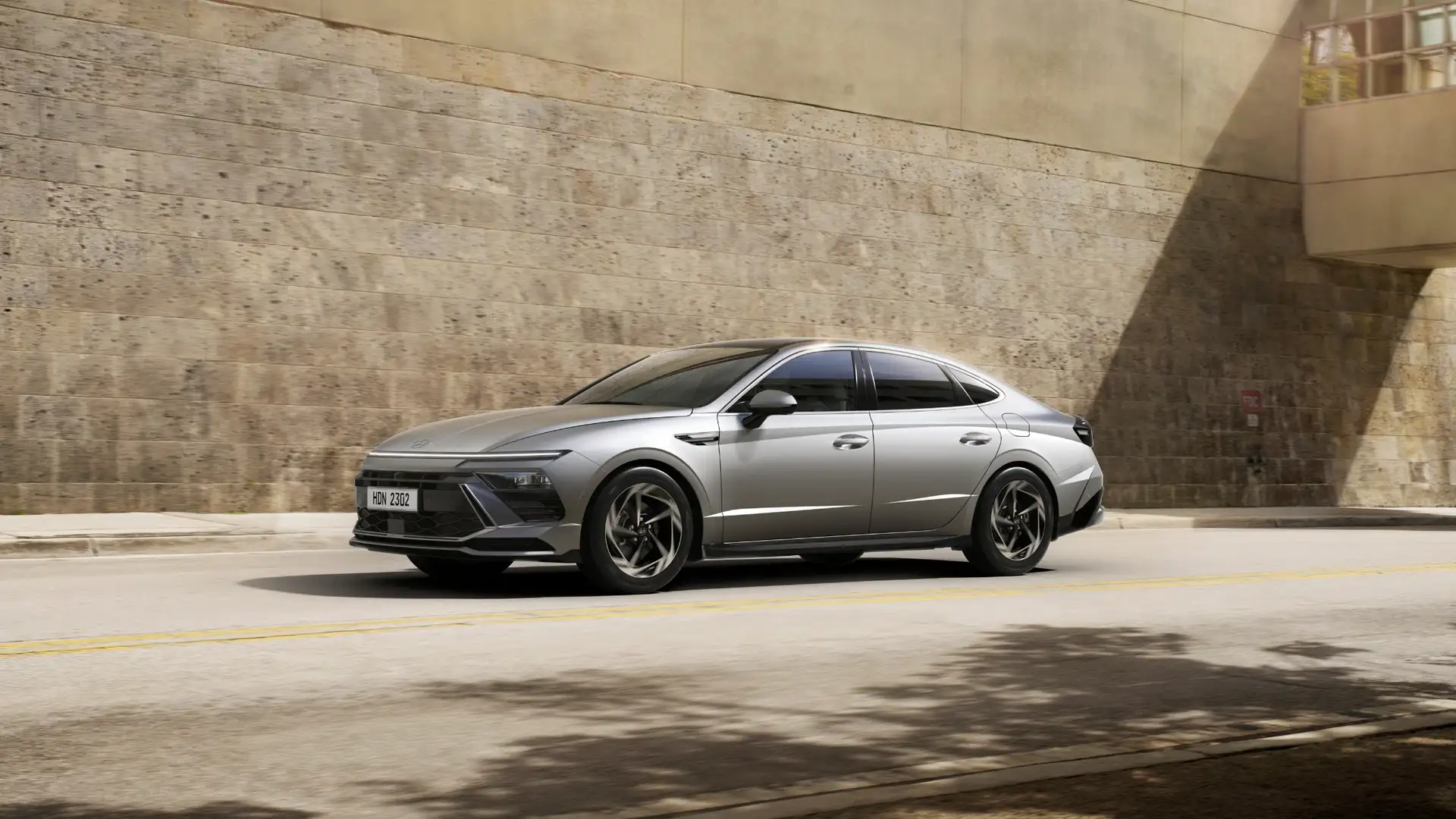
The 2026 Hyundai Sonata is engineered as a midsize sedan that prioritizes mechanical precision, structural integrity, and integrated vehicle systems. Its design reflects the brand’s continued development of scalable platforms that support multiple powertrain configurations while maintaining consistent ride quality and safety performance. Every major component, from drivetrain architecture to electronic systems, is configured to support efficiency, predictable handling, and long-term durability across varied driving conditions.
Powertrain Architecture and Output Engineering
The gasoline-powered 2026 Hyundai Sonata is offered with a Smartstream® 2.5-liter GDI plus MPI DOHC inline four-cylinder engine designed for balanced output and efficiency. This naturally aspirated engine displaces 2,497 cubic centimeters and produces 191 horsepower at 6,100 revolutions per minute along with 181 pound-feet of torque at 4,000 revolutions per minute. The engine utilizes a dual fuel injection system that combines direct injection and multi-port injection to improve combustion stability and reduce particulate emissions. Continuously variable valve timing supports optimized airflow across the operating range, while a 13.0:1 compression ratio improves thermal efficiency.
For higher-output applications, the 2026 Hyundai Sonata N Line incorporates a turbocharged version of the same 2.5-liter Smartstream® architecture. This turbocharged configuration delivers 290 horsepower at 5,800 revolutions per minute and 311 pound-feet of torque available from 1,650 through 4,000 revolutions per minute. A reduced compression ratio of 10.5:1 accommodates sustained boost pressure while maintaining combustion control. Hydraulic and conventional rubber engine mounts are used across all gasoline configurations to manage vibration and noise transmission into the cabin.
Hybrid models utilize a 2.0-liter GDI DOHC inline four-cylinder gasoline engine paired with a permanent magnet synchronous electric motor. The gasoline engine generates 150 horsepower at 6,000 revolutions per minute, while the electric motor contributes an additional 51 horsepower and 151 pound-feet of torque available from zero revolutions per minute. Combined system output is rated at 192 horsepower. Electrical energy is supplied by a 270-volt lithium-ion battery with a system capacity of 1.62 kilowatt-hours. Battery power output reaches 56 kilowatts, allowing the electric motor to assist during acceleration and low-load operation.
Transmission Systems and Drivetrain Configuration
The 2026 Hyundai Sonata 2.5-liter gasoline models are equipped with an 8-speed Smartstream® electronic automatic transmission that uses a torque converter with overdrive lock-up functionality. Gear ratios are selected to balance initial acceleration with efficient cruising, supported by smooth shift logic calibrated for daily driving conditions. Paddle shifters are available on select trims to allow manual gear selection without disengaging automatic operation.
The 2026 Hyundai Sonata N Line employs an 8-speed N Wet Dual Clutch Transmission engineered to manage increased torque output. This system uses wet-friction twin clutches to improve thermal control and shifting durability under higher loads. Gear spacing is optimized to maintain engine output within its effective power band during acceleration.
Hybrid variants use a 6-speed electronic automatic transmission with SHIFTRONIC® manual shift mode. Paddle shifters on hybrid trims are assigned to regenerative braking control in most drive modes, allowing the driver to adjust deceleration energy recovery. Front-wheel drive is standard across all configurations, while select 2.5-liter SEL Sport models offer HTRAC all-wheel drive. The all-wheel-drive system dynamically distributes torque to improve traction on low-grip surfaces.
Chassis Structure and Suspension Geometry
The 2026 Hyundai Sonata is constructed on a unibody chassis composed primarily of high-tensile steel. This material selection improves torsional rigidity while maintaining controlled weight distribution. The suspension system follows a consistent layout across all trims, with a MacPherson® strut front suspension and a multi-link rear suspension. Stabilizer bars and gas-charged shock absorbers are fitted at both ends to manage body motion and maintain predictable handling behavior.
Steering is handled by a motor-driven power steering system with rack-and-pinion geometry. Column-mounted power steering is used on standard trims, while rack-mounted steering is applied on performance-oriented configurations. Steering ratios vary slightly by trim, with quicker ratios assigned to the N Line to support more immediate steering response. Lock-to-lock steering turns are reduced on the N Line compared to standard models. All trims share a curb-to-curb turning diameter of 35.9 feet, supporting maneuverability in confined driving environments.
Brake Systems and Stability Control Integration
Braking systems are configured according to engine output and trim level. Standard 2.5-liter models use ventilated front disc brakes measuring 12.0 inches in diameter and solid rear disc brakes measuring 11.2 inches. The N Line receives larger ventilated front discs at 13.6 inches and solid rear discs measuring 12.8 inches. Hybrid models mirror the standard brake dimensions while integrating regenerative braking through the electric motor.
All configurations include anti-lock braking systems with electronic brake-force distribution and traction control. Electronic stability control and brake assist functions are standard. An electronic parking brake with automatic vehicle hold functionality is fitted across the lineup, supporting controlled stops in traffic conditions.
Exterior Lighting, Glass, and Aerodynamic Efficiency
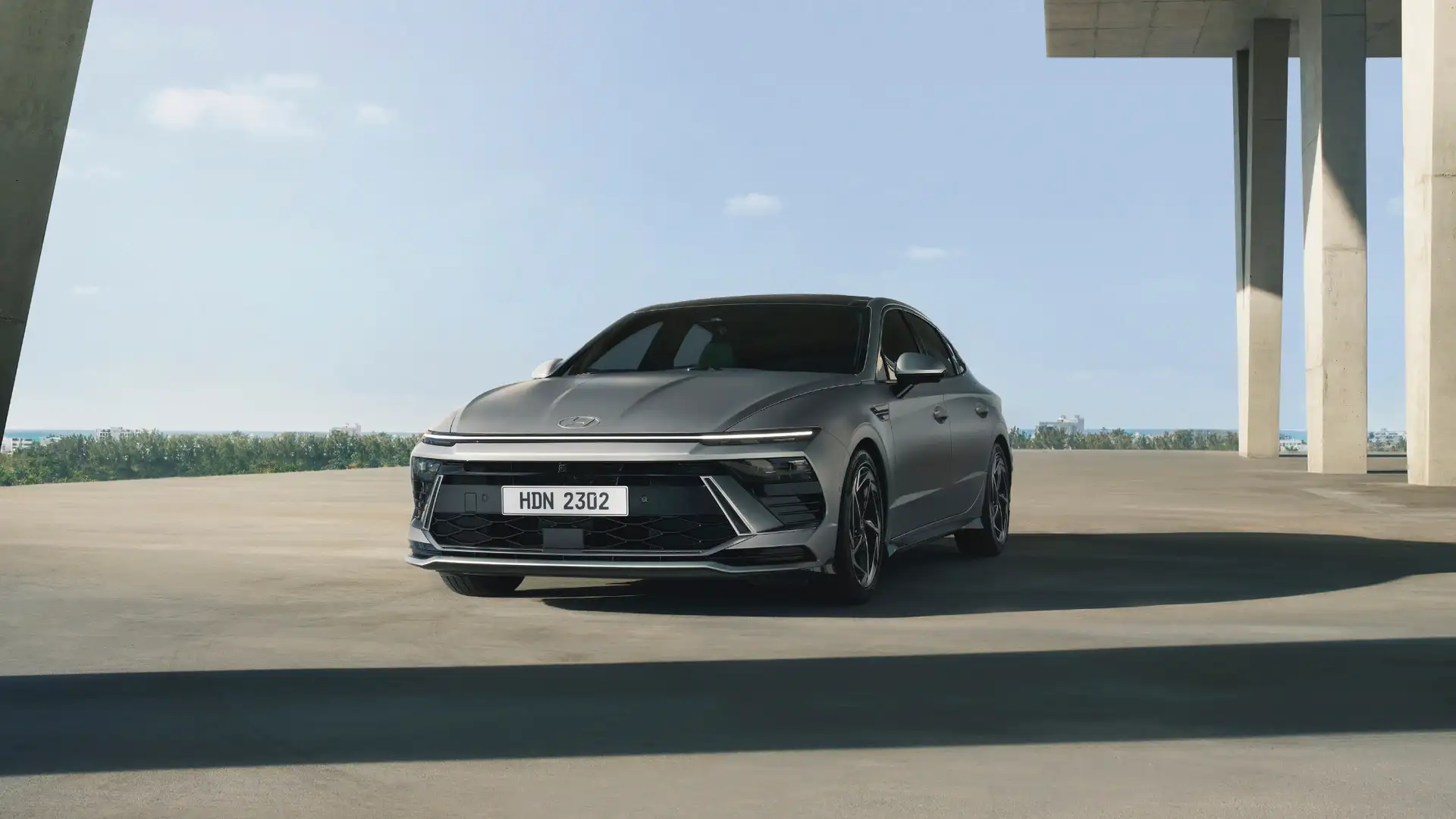
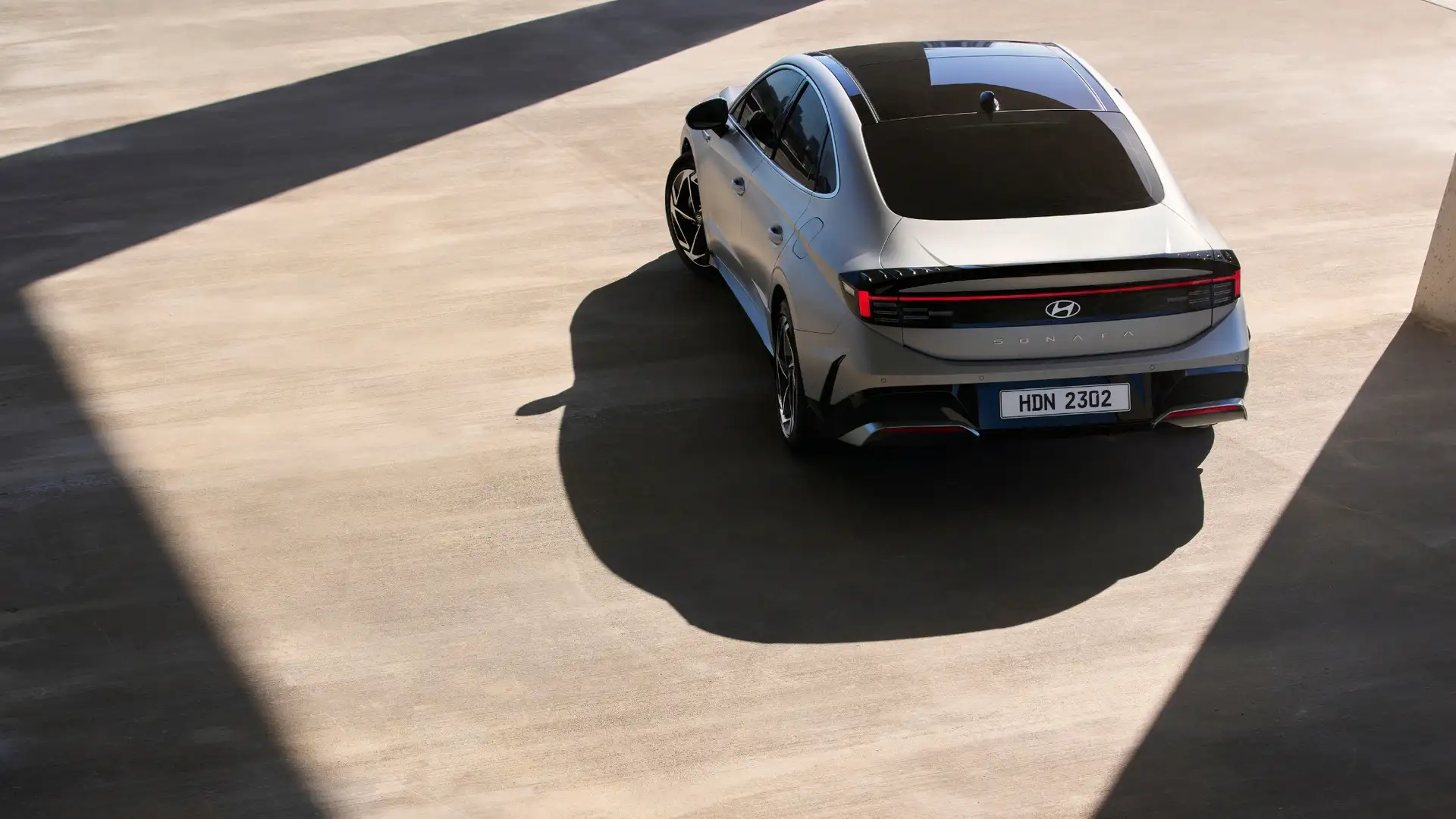
Exterior systems are designed to support visibility, acoustic management, and aerodynamic efficiency. LED projector-type headlights are standard across all trims, paired with automatic light control and automatic high-beam assist. LED rear combination taillights are fitted throughout the lineup, with center high-mounted stop lamps integrated into the rear design.
Solar-control glass is standard to reduce heat intrusion, while acoustic film is applied to the windshield and front door glass on select trims to limit wind and road noise. The aerodynamic profile of the 2026 Hyundai Sonata contributes to a low coefficient of drag, measured as low as 0.24 on hybrid models and 0.27 on gasoline configurations. This aerodynamic efficiency supports reduced fuel consumption and improved highway stability.
Wheel sizes range from 16-inch to 19-inch aluminum alloy designs, paired with tire widths appropriate to each trim. Tire pressure monitoring systems are standard, providing individual tire status alerts to the driver.
Interior Layout, Seating, and Climate Systems
The interior of the 2026 Hyundai Sonata is engineered to prioritize spatial efficiency and driver accessibility. Seating capacity is set at five occupants, with seating surfaces varying by trim. Standard models use premium cloth upholstery, while higher trims incorporate H-Tex® materials or leather-trimmed surfaces. The N Line features sport seats with additional bolstering to support lateral stability.
Front seats are available with manual or power adjustment, including power lumbar support on select trims. Heating and ventilation functions are included on higher trims to support thermal comfort. Rear seats use a 60-40 split-folding configuration, allowing expansion of the trunk area when required.
Climate control systems include manual air conditioning on base trims and dual automatic climate control with automatic defogging on upper trims. Rear air vents are integrated into the center console for second-row temperature distribution. Cabin air filtration is standard across all configurations.
Digital Displays and Connectivity Systems
Instrumentation and infotainment systems are centered around a 12.3-inch high-definition touchscreen interface. Standard audio systems support AM-FM, MP3 playback, HD Radio™, SiriusXM®, Bluetooth® connectivity, smartphone integration, and rearview camera display. Higher trims incorporate a navigation system with a 12.3-inch display and a Bose® premium audio system featuring twelve speakers and a dedicated subwoofer.
Wireless device charging, multiple USB ports, and rear passenger charging outlets are standard on most trims. Hyundai Bluelink® connectivity is included across the lineup, enabling remote vehicle access and system monitoring. Select trims offer Hyundai Digital Key 2.0 Premium, allowing compatible devices to function as vehicle keys. Instrument clusters are fully digital and configurable, with an available color head-up display projecting key driving information into the driver’s field of view.
Advanced Safety and Driver Assistance Systems
The 2026 Hyundai Sonata includes a comprehensive suite of active and passive safety systems. Passive safety features include front airbags, side-impact airbags, curtain airbags, and a driver knee airbag. Structural safety elements include front and rear crumple zones, bodyside reinforcements, hood buckling creases, and an energy-absorbing steering column.
Active safety technologies include forward collision-avoidance assist with pedestrian and cyclist detection, lane keeping assist, lane follow assist, driver attention warning, blind-spot collision warning, rear cross-traffic collision-avoidance assist, and safe exit warning. Rear occupant alert systems monitor rear door usage to reduce the risk of unattended occupants. Higher trims add surround-view monitoring, blind-spot view monitoring, parking collision-avoidance assist, and highway driving assist.
Dimensions, Capacity, and Structural Efficiency
The 2026 Hyundai Sonata features a wheelbase measuring 111.8 inches, contributing to interior legroom and ride stability. Overall length measures 193.3 inches, while overall width measures 73.2 inches excluding mirrors. Overall height is set at 56.9 inches. Passenger compartment volume totals 104.4 cubic feet, while trunk cargo capacity measures 15.6 cubic feet.
Fuel tank capacity is rated at 15.9 gallons for gasoline models and 13.2 gallons for hybrid models. Curb weight varies by configuration, ranging from approximately 3,232 pounds for base models to 3,687 pounds for higher hybrid trims. Towing capacity is not recommended across all configurations.
Visit ALM Hyundai of Athens to Schedule a Test Ride
Drivers interested in evaluating the mechanical design, integrated technology, and safety systems of the 2026 Hyundai Sonata can benefit from direct on-road assessment. A scheduled drive allows evaluation of power delivery, steering response, braking behavior, and cabin ergonomics under typical driving conditions. Advanced driver assistance systems can also be observed in active operation during controlled scenarios. For those seeking detailed familiarity with the vehicle’s engineering and system integration, ALM Hyundai of Athens near Commerce, GA, offers opportunities to arrange a test drive and explore available configurations in person.