

2026 Hyundai IONIQ 5 near Buford, GA
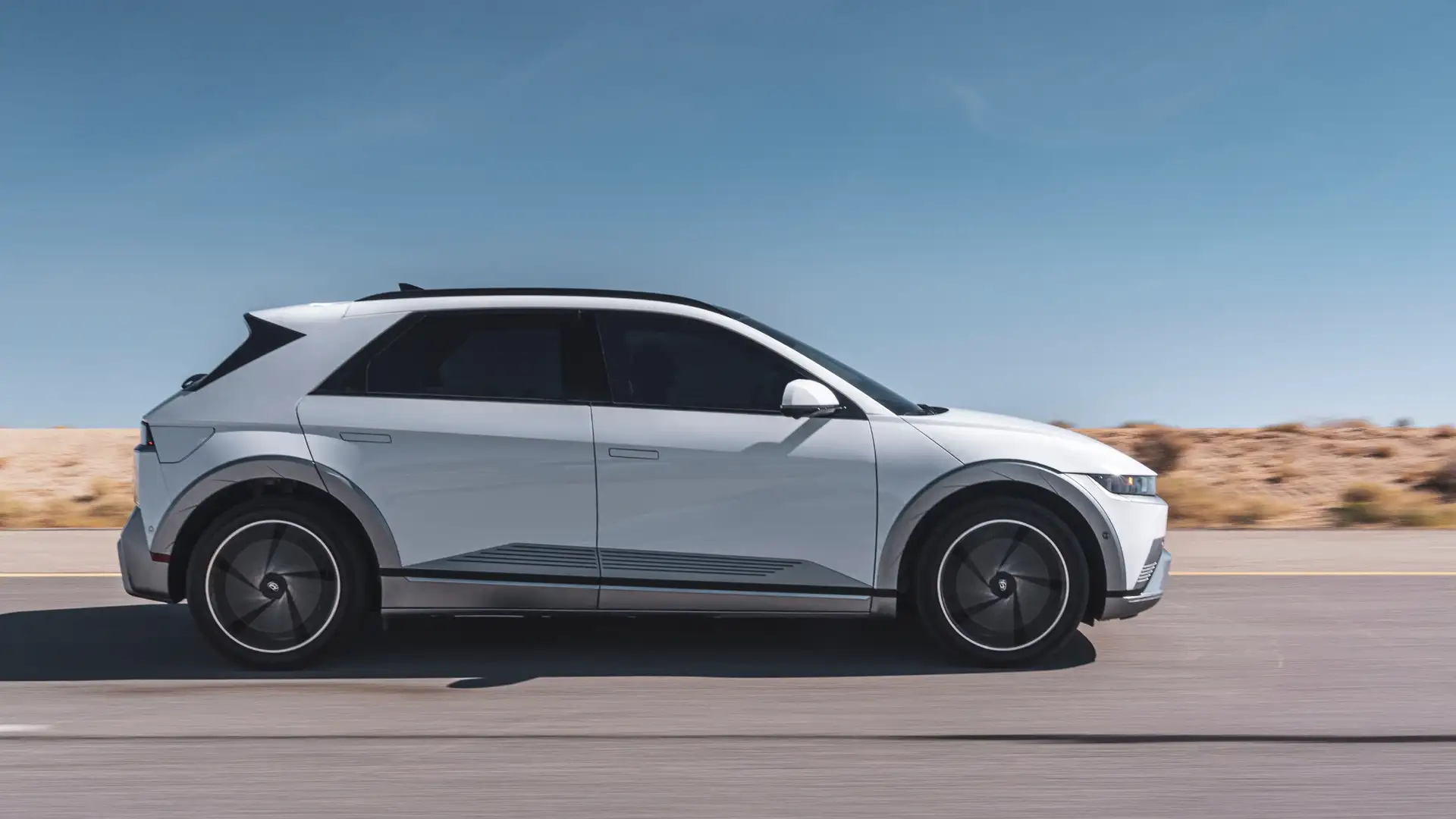
The 2026 Hyundai IONIQ 5 is engineered on a dedicated electric vehicle platform that supports optimized packaging, high-voltage efficiency, and structural rigidity. This architecture allows the vehicle to house its battery system within the floor structure, contributing to a low center of gravity and balanced weight distribution. The design supports both rear-wheel-drive and all-wheel-drive configurations without mechanical compromise. Electrical systems operate on either a 523-volt or 697-volt architecture depending on battery size and drivetrain, enabling compatibility with high-capacity charging systems. Every structural and electrical element is integrated to support predictable performance, thermal stability, and consistent energy delivery.
Electric Motor Output and Drive System Configuration
The propulsion system of the 2026 Hyundai IONIQ 5 utilizes permanent-magnet synchronous motors designed for immediate torque response and sustained output. Rear-wheel-drive standard-range models produce 125 kW, equivalent to 168 horsepower, while extended-range rear-wheel-drive variants increase output to 168 kW, or 225 horsepower. All-wheel-drive models combine a front and rear motor to achieve a total system output of 320 horsepower. Maximum torque ranges from 350 Nm in rear-wheel-drive configurations to 605 Nm in all-wheel-drive models, providing strong low-speed acceleration and controlled power delivery at higher speeds.
Power is transferred through a single-speed reduction gear transmission with electronic shift-by-wire control. Gear and final drive ratios are calibrated to balance efficiency and acceleration while maintaining smooth operation. The drive system supports electronically governed maximum speeds up to 115 miles per hour. Drive Mode Select allows transitions between Eco, Normal, Sport, and Snow modes through steering-wheel-mounted controls, adjusting throttle mapping, steering response, and regenerative braking behavior.
High-Voltage Battery Design and Energy Management
Battery systems in the 2026 Hyundai IONIQ 5 are lithium-ion units supplied by SK Innovation and configured in modular cell assemblies. The standard-range battery provides a total capacity of 63.0 kWh, while long-range configurations utilize an 84.0 kWh system. Cell construction varies by battery size, with standard-range models using 288 cells across 24 modules and long-range models using 384 cells across 32 modules. Battery weight differs accordingly, supporting thermal management and structural protection without excessive mass.
Energy management is supported by an onboard charger rated at 10.9 kW and a battery preconditioning function designed to stabilize temperature prior to charging. The system integrates with regenerative braking hardware to recover energy during deceleration. Regenerative braking levels are adjustable using steering wheel paddles, allowing drivers to influence energy recovery based on driving conditions. The battery system is engineered to maintain consistent output across a wide operating range.
Charging Capability Across Multiple Power Standards
Charging flexibility is a defining technical feature of the 2026 Hyundai IONIQ 5. AC Level II charging using a standard 240-volt connection replenishes the standard-range battery from 10 percent to full charge in approximately five hours and forty minutes. Long-range battery configurations require approximately seven hours and twenty minutes under the same conditions. DC fast charging is supported through multiple voltage standards, including 400-volt and 800-volt systems.
When connected to a DC fast charger rated above 250 kW using an 800-volt architecture, the battery can charge from 10 percent to 80 percent in approximately 20 minutes under optimal conditions. The vehicle also supports DC fast charging through lower-output systems using CCS adapters. Charging rates vary based on charger capability, ambient temperature, and battery state, with onboard systems managing current flow to protect battery longevity.
Disclaimer: Approximately 20 minutes to charge from 10% to 80% on a 350-kW, 800V DC ultra-fast charger using the CCS adapter included with the 2026 IONIQ 5. Actual charging time varies based on a number of factors, including current battery charge level, output of the charging unit, vehicle and battery settings, battery temperature and outside temperature. Ultra-fast charging stations are provided by independent companies and availability is not guaranteed.
Steering Precision and Chassis Control Systems
The steering system employs a rack-and-pinion design with motor-driven power assist mounted directly to the rack. This configuration provides consistent feedback and reduces mechanical complexity. The steering ratio is set at 14.26:1 with a turning diameter of 39.4 feet curb to curb, allowing controlled maneuverability in urban environments. Steering response adjusts automatically based on selected drive mode.
The suspension design includes a MacPherson® strut front suspension and a multi-link rear suspension with high-performance dampers. This layout supports ride stability, wheel control, and consistent tire contact across varying road surfaces. XRT models add terrain mode selection for snow, mud, and sand, modifying traction control and torque distribution accordingly. The chassis structure is a unibody design constructed primarily from advanced high-strength steel and high-tensile steel to enhance rigidity and impact management.
Braking Systems and Regenerative Integration
Braking hardware includes ventilated front disc brakes and solid rear disc brakes, supported by an anti-lock braking system with electronic brake-force distribution. An active hydraulic brake booster works in conjunction with the regenerative braking system to provide consistent pedal feel. Regenerative braking recaptures kinetic energy and returns it to the battery during deceleration, improving overall efficiency.
Additional braking features include hill-start assist control, brake assist, an electronic parking brake with automatic vehicle hold, and stability management systems that integrate traction control and electronic stability control. These systems operate continuously to support predictable braking performance under varying load and surface conditions.
Aerodynamic Exterior Engineering and Lighting Systems
Exterior dimensions and surface treatments are designed to reduce drag while maintaining structural integrity. The vehicle achieves a coefficient of drag as low as 0.282, supported by active grille shutters that regulate airflow through the front fascia. Flush-type door handles deploy automatically during entry and retract during motion to reduce turbulence. Roofline and rear spoiler geometry support aerodynamic balance at highway speeds.
Lighting systems rely entirely on LED technology, including daytime running lights, headlights, taillights, and center high-mount stop lamps. Select trims include projector-type LED headlights and premium front accent lighting. Exterior mirrors integrate heating, blind-spot indicators, and LED turn signal indicators. Acoustic windshield glass and laminated panels contribute to reduced exterior noise transmission.
Interior Configuration and Functional Space Utilization
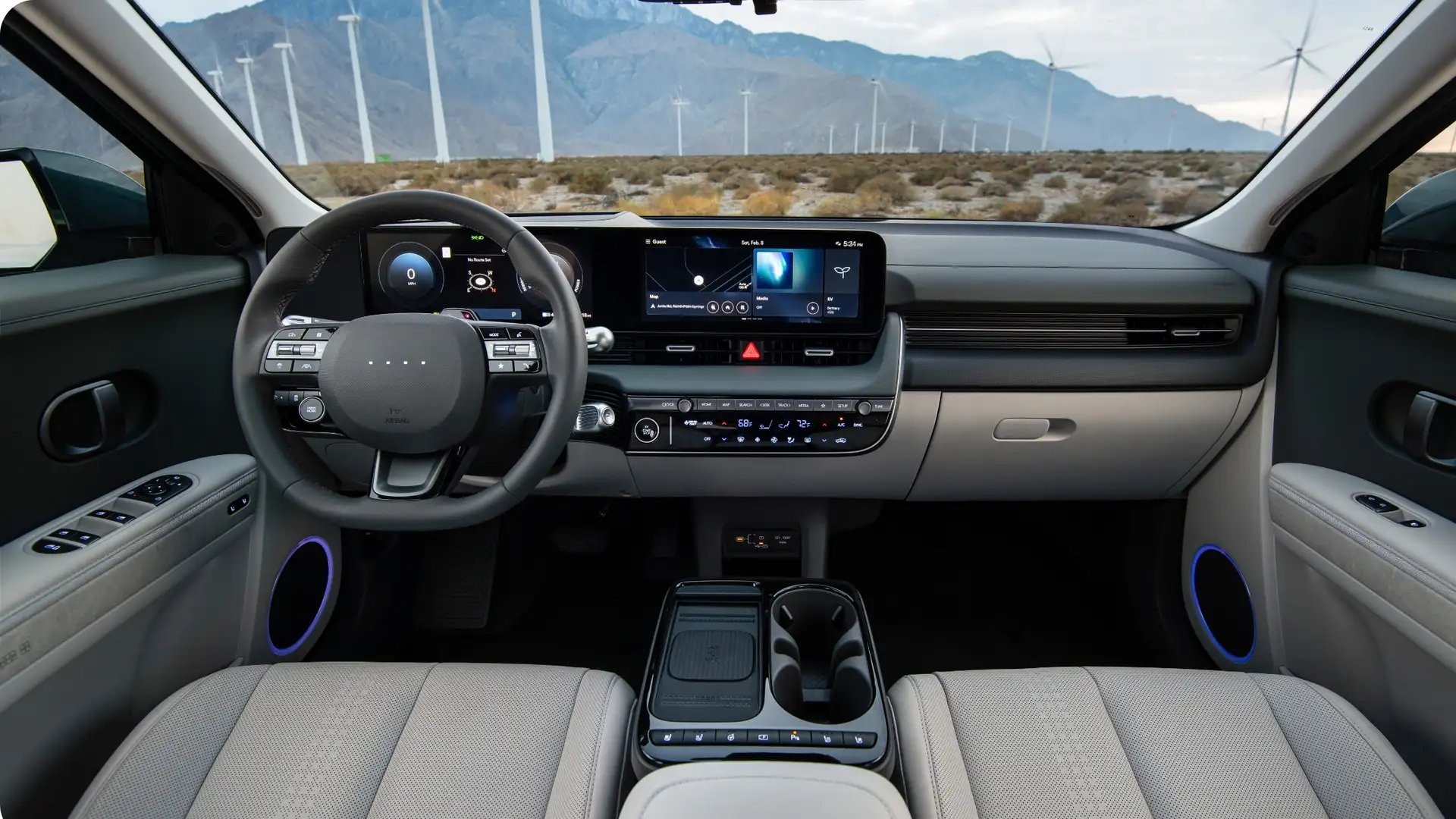
The interior layout benefits from the flat-floor electric platform, allowing efficient use of cabin space. Seating capacity is five across all trims, with seating surfaces ranging from stain-resistant cloth to H-Tex® artificial leather. Front seats include power adjustment, lumbar support, heating, and optional ventilation. Higher trims add memory settings and a relaxation function designed for stationary use.
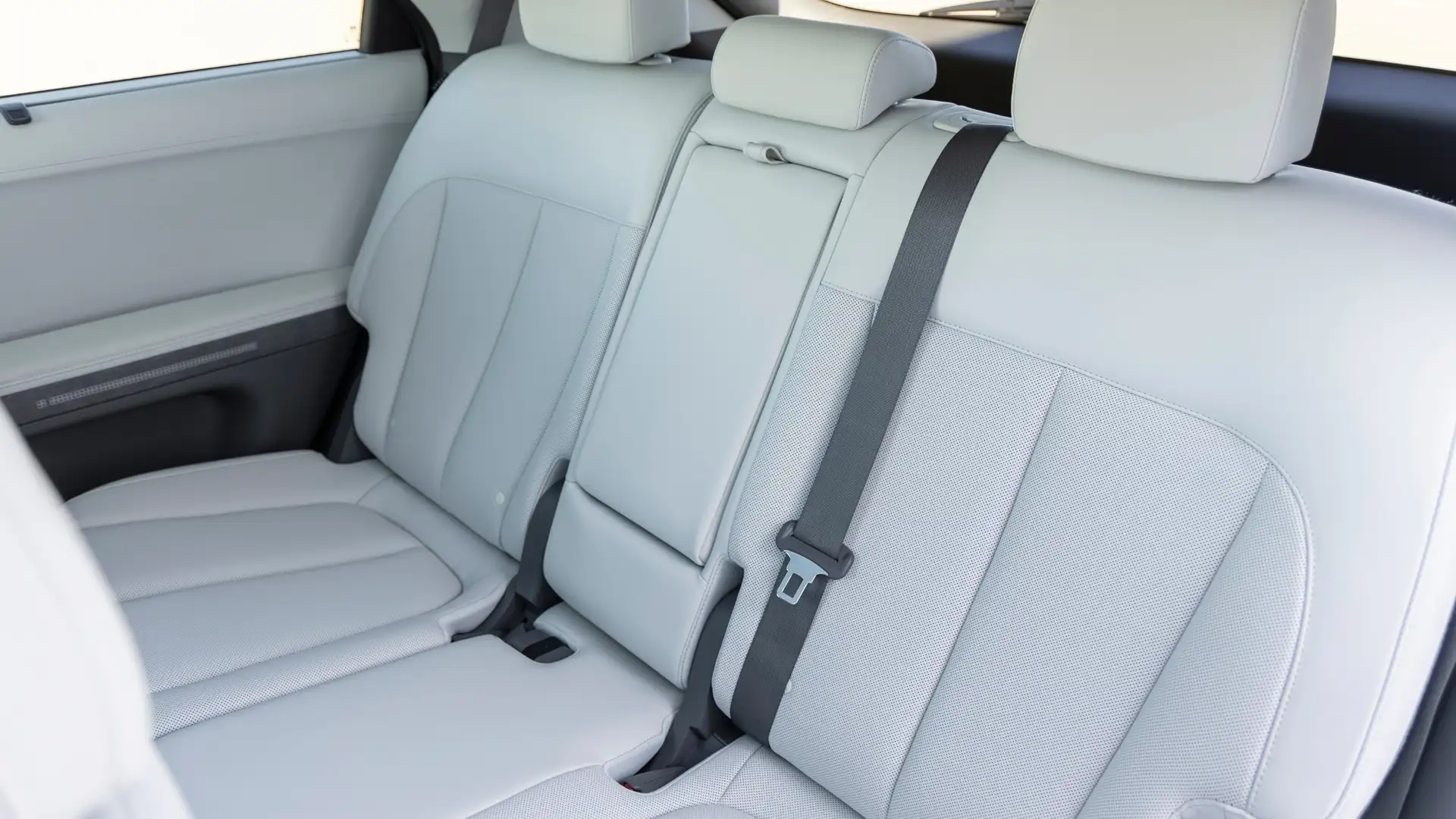
Rear seating includes a 60/40 split folding bench with sliding and reclining capability. Cargo capacity measures 26.3 cubic feet with rear seats upright and expands to 58.5 cubic feet with seats folded. A front trunk provides additional storage capacity. Interior materials emphasize durability, soft-touch surfaces, and functional placement of controls.
Digital Displays and Integrated Technology Systems
Instrumentation consists of a 12.3-inch digital instrument cluster paired with a 12.3-inch center touchscreen. The system displays vehicle status, energy usage, navigation data, and driver-assistance information. Wireless Apple CarPlay® and Android Auto™ are supported, along with Bluetooth® multi-device connectivity. USB-C outlets are distributed across both seating rows for power and data access.
Available features include a premium head-up display, wireless phone charging rated at 15 watts, and a Bose® premium audio system with external amplification. Vehicle-to-load capability allows compatible trims to supply electrical power to external devices using the onboard charging system. Telematics integration supports remote vehicle access, charge monitoring, and connectivity features through the vehicle’s interface.
Driver-Assistance and Safety System Integration
Safety systems combine structural protection with a broad range of driver-assistance technologies. Airbag coverage includes front, side-impact, curtain, and rear side airbags. Seatbelt systems incorporate pretensioners and load limiters across all outboard seating positions. Child safety features include rear door locks and LATCH anchor systems.
Active safety technologies include forward collision-avoidance assist with pedestrian and cyclist detection, blind-spot collision-avoidance assist, rear cross-traffic collision-avoidance assist, lane-keeping assist, and lane-following assist. Higher trims add surround-view monitoring, blind-spot view monitoring, and advanced highway driving assist functions. Driver attention monitoring and intelligent speed limit assist operate continuously to support situational awareness.
Vehicle Dimensions and Structural Balance
The 2026 Hyundai IONIQ 5 measures 183.3 inches in overall length with a wheelbase of 118.1 inches. Overall width measures 74.4 inches, while height ranges from 63.0 inches to 64.0 inches depending on trim. Ground clearance ranges from 6.1 inches to 7.0 inches on XRT models. Interior volume totals 132.8 cubic feet, with passenger volume measuring 106.5 cubic feet. These dimensions support a stable footprint and efficient interior packaging.
Schedule a Test Ride near Buford, GA
Drivers interested in understanding how the 2026 Hyundai IONIQ 5 performs across acceleration, steering response, and braking can evaluate these systems through a scheduled test drive. At ALM Hyundai of Athens near Buford, GA, customers can examine drivetrain responsiveness, digital display clarity, and advanced driver-assistance functionality in a practical setting. A test drive allows direct assessment of torque delivery, regenerative braking behavior, and ride stability. Evaluating charging interfaces and interior technology during an in-person visit provides additional technical context. Scheduling a test drive offers a structured opportunity to experience how the vehicle’s engineering translates into everyday operation.