

2026 Hyundai Elantra near Loganville, GA
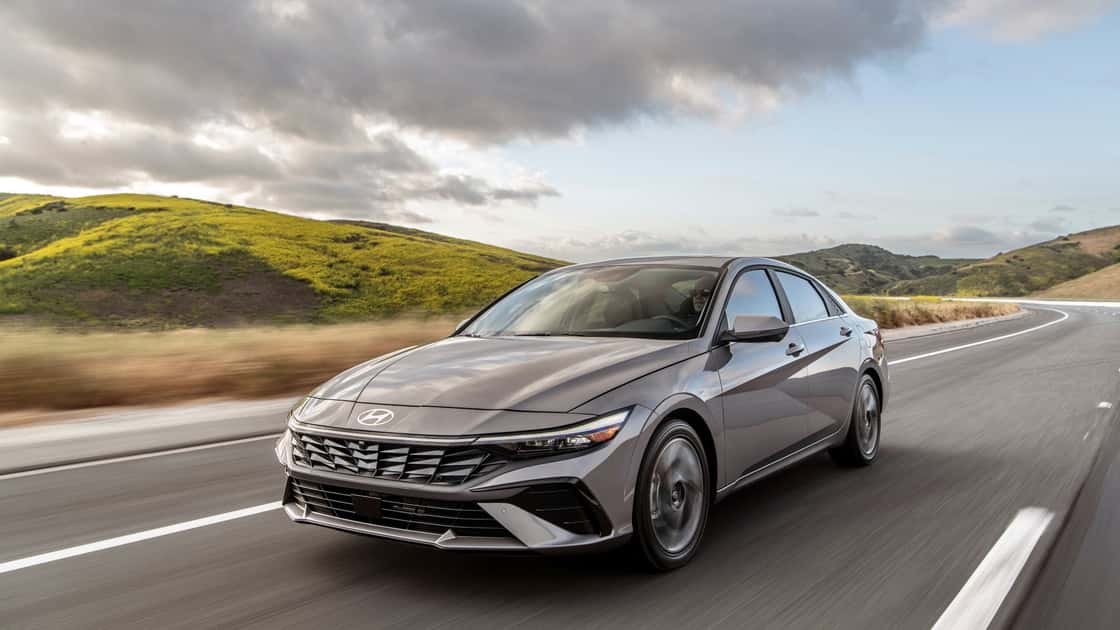
The 2026 Hyundai Elantra is engineered with multiple powertrain configurations, structural enhancements, and integrated systems designed to meet varying operational requirements across its trim range. The model includes gasoline, hybrid, turbocharged, and high-performance variants, each defined by distinct mechanical specifications. The 2026 Hyundai Elantra utilizes a unibody structure constructed primarily of high-tensile steel, supporting durability, structural rigidity, and controlled energy absorption during impact scenarios. Its front-wheel drive configuration remains consistent across all trims, ensuring predictable drivetrain behavior and packaging efficiency.
Engine Architecture and Output Specifications
The standard gasoline configuration uses a 2.0-liter multi-port injection Atkinson cycle inline four-cylinder engine. This engine has a displacement of 1,999 cc and incorporates dual continuously variable valve timing with a 16-valve DOHC design. It produces 147 horsepower at 6,200 rpm and 132 lb-ft of torque at 4,500 rpm. The aluminum block and cylinder head contribute to reduced engine weight and improved thermal efficiency.
Hybrid models integrate a 1.6-liter gasoline direct-injected Atkinson cycle engine with a displacement of 1,580 cc. The gasoline engine produces 104 horsepower and 109 lb-ft of torque. Combined system output reaches 139 horsepower and 195 lb-ft of torque when paired with an electric motor rated at 32 kW or 43 horsepower and 125 lb-ft of torque. The hybrid system uses a lithium-ion battery with a 240-volt configuration and a capacity of 1.32 kWh, supporting energy regeneration and electric assist functionality.
The N Line trim introduces a 1.6-liter turbocharged gasoline direct-injected engine with continuously variable valve duration. This configuration generates 201 horsepower at 6,000 rpm and 195 lb-ft of torque across a wide range from 1,500 to 4,500 rpm. The 2026 Hyundai Elantra N model increases performance capability through a 2.0-liter turbocharged direct-injected engine. This engine produces 276 horsepower between 5,500 and 6,000 rpm and 289 lb-ft of torque between 2,100 and 4,700 rpm, providing a broader torque curve for sustained acceleration.
Transmission Systems and Drive Modes
Transmission configurations vary by engine application. The standard gasoline engine pairs with a Smartstream® Intelligent Variable Transmission designed to optimize fuel efficiency and smooth acceleration. Hybrid variants use a 6-speed EcoShift® dual-clutch transmission, allowing for direct mechanical engagement and efficient power transfer from both the internal combustion engine and electric motor.
The N Line trim offers a 6-speed manual transmission and a 7-speed dual-clutch transmission with paddle shifters. The 2026 Hyundai Elantra N includes an 8-speed wet dual-clutch transmission designed for higher torque capacity and improved thermal management. Manual shift control is supported through SHIFTRONIC® functionality on compatible systems.
Drive Mode Select is included on automatic and dual-clutch configurations. Available modes include Normal, Sport, and Smart across most trims. The 2026 Hyundai Elantra N expands drive mode functionality with Eco, Normal, Sport, and N Custom modes, allowing adjustments to throttle response, transmission behavior, and steering calibration.
Suspension Systems and Chassis Dynamics
Front suspension across all trims uses a MacPherson® strut design with coil springs and stabilizer bars. The stabilizer bar diameter varies depending on trim, ranging from 22 mm to 23 mm. Rear suspension differs based on configuration. Standard gasoline trims utilize a coupled torsion beam axle, while hybrid, N Line, and N models incorporate a multi-link independent rear suspension system for improved handling characteristics.
The 2026 Hyundai Elantra N includes additional chassis reinforcements such as a rear chassis brace and an electronically controlled, limited-slip differential known as the N Corner Carving Differential. This system distributes torque between the front wheels to improve cornering stability and traction under load. The N variant also includes electronically controlled suspension components, allowing adaptive damping adjustments.
Steering Configuration and Control Precision
The steering system uses a rack-and-pinion layout across all trims. Most configurations employ column-mounted motor-driven power steering with a steering ratio of 12.9:1 and approximately 2.5 turns lock-to-lock. The 2026 Hyundai Elantra N uses rack-mounted motor-driven power steering, providing a quicker steering ratio of 12.2:1 and reducing lock-to-lock turns to 2.2. This configuration enhances steering response and directional accuracy.
The minimum turning radius for standard trims is approximately 17.7 feet, while the 2026 Hyundai Elantra N has a slightly larger turning radius of 19.2 feet due to its performance-oriented geometry.
Brake System Design and Performance
The braking system consists of four-wheel disc brakes with Anti-lock Braking System and Electronic Brake-force Distribution. Standard trims feature 11.0-inch ventilated front discs and 10.3-inch solid rear discs. The N Line increases front brake size to 12.0 inches. The 2026 Hyundai Elantra N uses larger ventilated discs measuring 14.2 inches at the front and 12.4 inches at the rear, supporting higher thermal capacity and braking performance.
Brake Assist is standard across all trims. Hybrid models incorporate regenerative braking supported by an electric brake booster, contributing to energy recovery and system efficiency. Parking brake systems vary between mechanical cable-operated designs and electronic parking brakes, depending on trim level.
Exterior Dimensions, Aerodynamics, and Wheel Configurations
The 2026 Hyundai Elantra has a wheelbase of 107.1 inches, an overall length of 185.4 inches, and a width of 71.9 inches. Standard height measures approximately 55.7 inches, with minor variations across trims. The vehicle achieves a coefficient of drag as low as 0.28, supporting aerodynamic efficiency.
Wheel sizes range from 15-inch alloy wheels on entry trims to 19-inch alloy wheels on the 2026 Hyundai Elantra N. Tire specifications include 195/65R15, 205/55R16, 225/45R17, 235/40R18, and 245/35R19, depending on configuration. High-performance variants use summer tires designed for increased grip and handling stability.
Lighting systems include LED daytime running lights and dual LED projector headlights across all trims. Automatic headlamp control and High Beam Assist are standard. Rear lighting configurations vary, including bulb, LED combination, and full LED systems, depending on trim selection.
Interior Dimensions and Seating Configuration
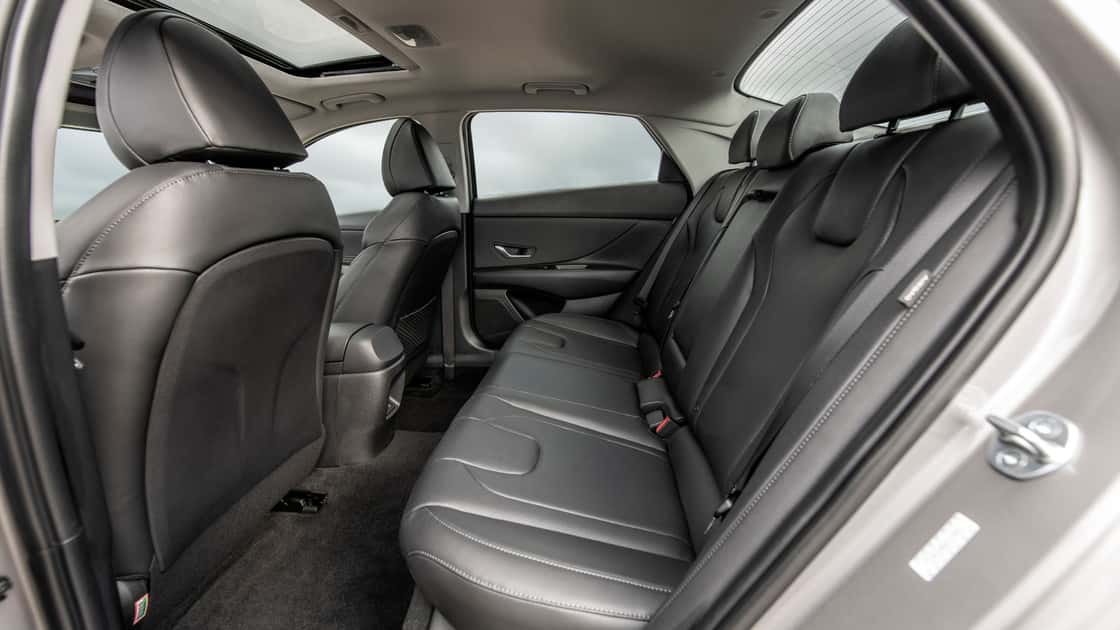
The cabin accommodates five occupants with a total passenger volume of 99.4 cubic feet. Cargo capacity measures 14.2 cubic feet, resulting in a total interior volume of 113.6 cubic feet. Front headroom measures 40.6 inches, or 38.7 inches when equipped with a sunroof. Rear headroom measures 37.3 inches. Front legroom is 42.3 inches, while rear legroom is 38.0 inches.
Seating configurations include premium cloth, leatherette, and leather-trimmed surfaces, depending on trim. The driver’s seat provides 6-way manual adjustment, while the front passenger seat offers 4-way adjustment. Higher trims include a power driver seat with lumbar support, memory settings, and ventilated front seats. Heated front seats are available on select trims.
Rear seating includes either a one-piece folding seatback or a 60/40 split fold-down configuration with adjustable headrests and an integrated armrest. Trunk access for seat folding is available across all trims.
Infotainment Systems and Connectivity Integration
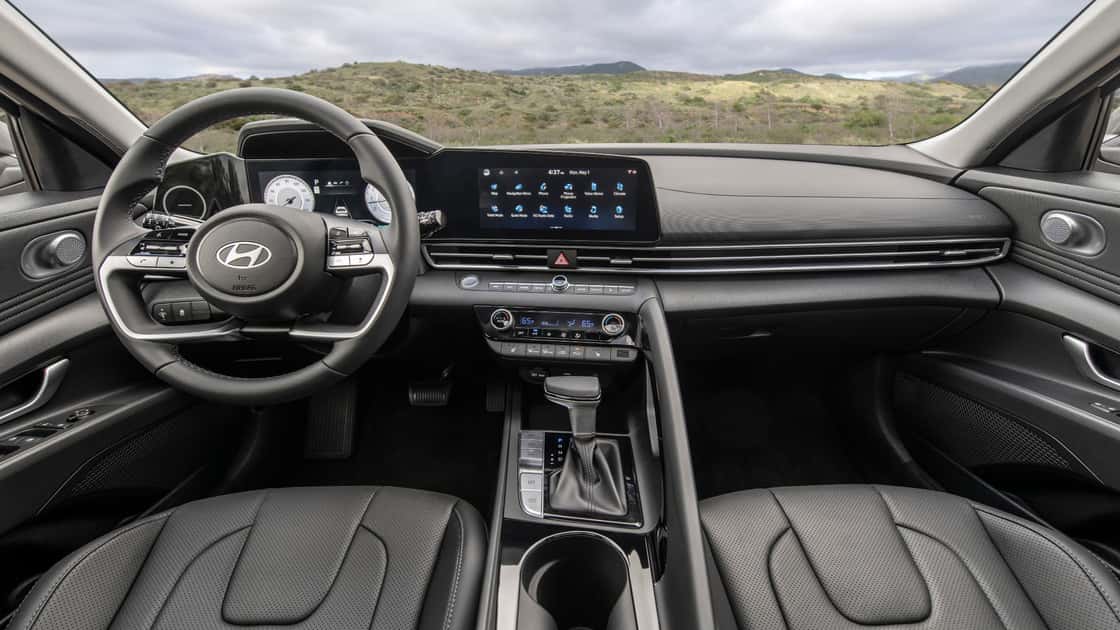
The base infotainment system uses an 8-inch touchscreen display with six speakers. It includes AM, FM, and HD Radio™, wireless Apple CarPlay®, and wireless Android Auto™ integration. A rearview camera with Dynamic Guidance is included.
Higher trims feature a 10.25-inch touchscreen navigation system with integrated navigation services, SiriusXM® satellite radio, and additional data services such as traffic and weather information. The system supports wired Apple CarPlay® and Android Auto™ functionality.
Audio upgrades include a Bose® premium sound system with eight speakers, a center channel, and a subwoofer. Bluetooth® hands-free connectivity with voice recognition is standard. Additional features include dynamic voice recognition, wireless device charging, dual front USB ports, rear USB-C charging ports, and Wi-Fi hotspot capability on navigation-equipped models.
Climate Control and Interior Functional Systems
Climate control systems vary by trim. The SE trim uses manual air conditioning, while other trims use dual automatic temperature control systems. Rear seat heating ducts and a rear window defroster are standard across all trims.
Interior control systems include tilt-and-telescopic steering adjustment, integrated audio and cruise control buttons, and instrument cluster displays with digital odometers, trip information, and system indicators. Select trims include advanced instrumentation such as performance gauges for turbocharged models, displaying parameters such as boost pressure, oil temperature, and coolant temperature.
Convenience features include power windows with driver auto-down or auto-up functionality depending on trim, power door locks, remote trunk and fuel door release, center console storage, and multiple charging ports. Additional available features include proximity key entry, push-button start, digital key capability, hands-free trunk release, and auto-dimming mirrors.
Safety Systems and Driver Assistance Technologies
The 2026 Hyundai Elantra incorporates a full set of passive and active safety systems. Airbag coverage includes front airbags, front side-impact airbags, and side curtain airbags for both front and rear occupants. Seatbelt systems include pretensioners and adjustable anchors. Child safety systems include LATCH anchors and rear door child locks.
Active safety systems include Anti-lock Braking System, Electronic Stability Control, Vehicle Stability Management, Traction Control System, and Hill Start Assist Control. Tire Pressure Monitoring System is also standard.
Driver assistance features include Forward Collision-Avoidance Assist with pedestrian detection on multiple trims. Higher trims add expanded detection capabilities for cyclists and junction turning scenarios. Blind-Spot Collision Warning with Rear Cross-Traffic Collision-Avoidance Assist is standard across the lineup. Lane Keeping Assist and Lane Following Assist support directional stability. Driver Attention Warning monitors driver behavior, while High Beam Assist adjusts headlight output automatically.
Additional systems include Safe Exit Warning, Rear Occupant Alert, and Intelligent Speed Limit Assist. Select trims include Smart Cruise Control with Stop and Go functionality and Highway Driving Assist, which supports semi-automated driving functions under specific conditions. Parking assistance features, such as forward and reverse distance warning, are included on performance trims.
Schedule a Test Ride near Loganville, GA
Drivers seeking a detailed understanding of the 2026 Hyundai Elantra can evaluate its systems through a scheduled test drive at ALM Hyundai of Athens near Loganville, GA. This allows direct assessment of the 2.0-liter gasoline engine, hybrid system integration, and turbocharged configurations under controlled driving conditions. The test drive also provides an opportunity to observe transmission response, steering calibration, and braking performance across different drive modes. Interior systems such as the infotainment interface, connectivity features, and driver-assistance technologies can be examined in operation. Scheduling a visit ensures access to the full range of technical configurations and system demonstrations available in the current 2026 Hyundai Elantra lineup.